-
Title
-
Tara White, November 11, 2020 (video)
-
interviewee
-
Tara White
-
interviewer
-
Megan McGee
-
Date
-
2020-11-11
-
Subject
-
Aurora, IL
-
Community
-
Cooperstown Graduate Association
-
Cooperstown Graduate Program
-
David Lewis
-
Hands-on experience
-
Relationships
-
Description
-
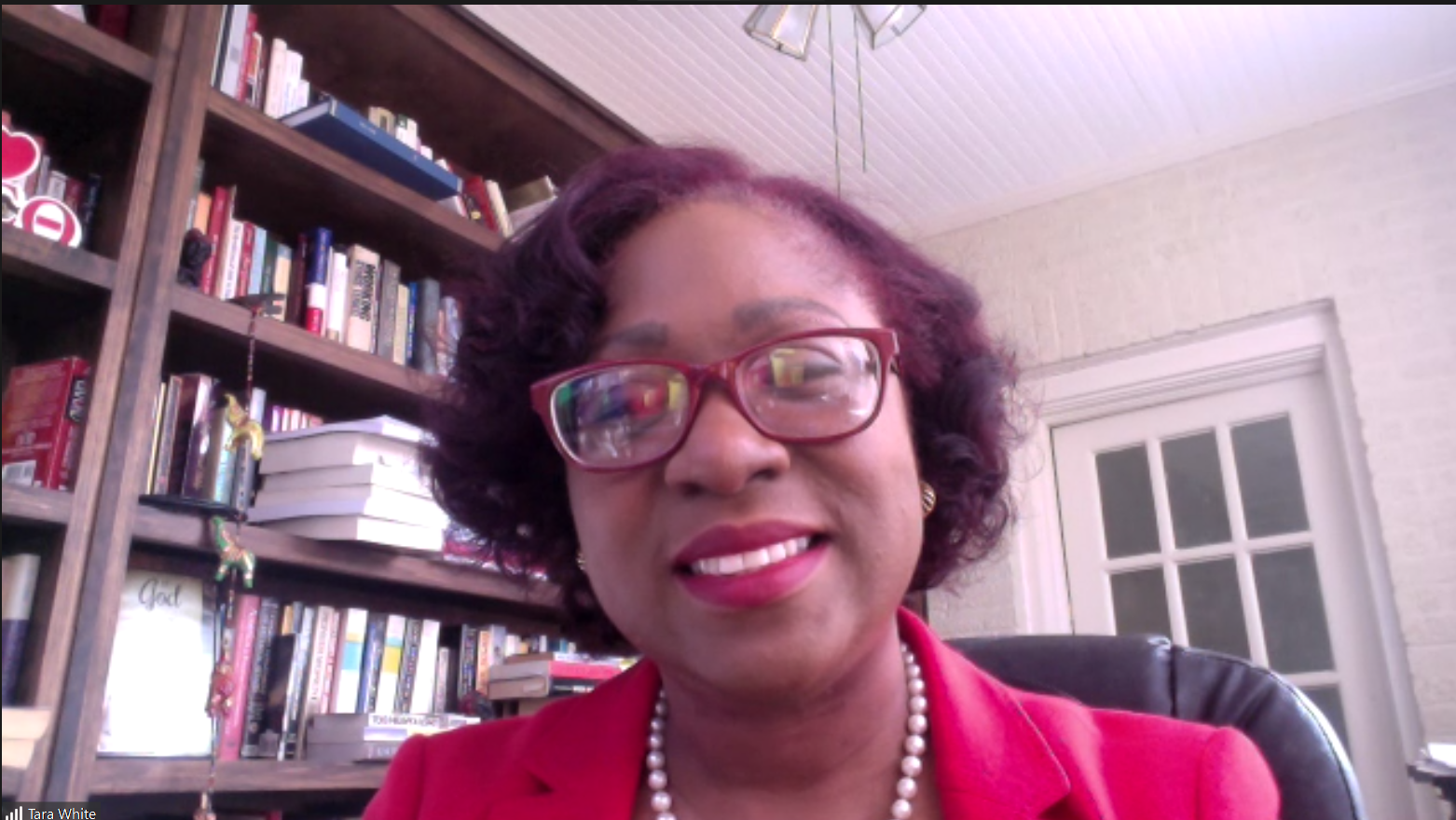
Dr. Tara White is an esteemed alumna of the Cooperstown Graduate Program, as well as a prominent historian in the fields of women's history and Black history. She was born in 1971 in Montgomery, Alabama, where she resides now. She is currently a professor of history at Wallace Community College in Selma, Alabama.
Dr. White graduated from the University of Alabama at Birmingham with her bachelor's degree in biology and chemistry prior to her time at the Cooperstown Graduate Program. She attended the Program from 1997 to 1998, and received her master's degree in 1998, before pursuing a PhD at Middle Tennessee State University. She is a member of the Cooperstown Graduate Association.
Dr. White's recollections of her time while at the Cooperstown Graduate Program range from fond memories of her community in the Program and in the Village of Cooperstown, to instances of microaggressions she faced as a Black woman, to observations about urban life versus rural life. Some of the most interesting moments from the interview were when she discussed some of the relationships she was able to build during her time at the program.
This interview occurred during the Covid-19 pandemic, and, as a result, I interviewed Dr. White remotely via Zoom. She was at her home in Montgomery, Alabama. Dr. White is a Southern lady, and as a result often uses Southern expressions, which I have kept intact. Her identity as a Southerner is a major source of discussion throughout the interview.
-
Transcription
-
TW = Dr. Tara White
MM = Megan McGee
[START OF TRACK 1, 0:00]
MM:
This is the video segment of the interview of Dr. Tara White by Megan McGee with the Cooperstown Graduate Program. Dr. White, would you mind telling us a little bit about your community at Cooperstown?
TW:
Oh, yes. My community at Cooperstown was - they were warm, they were affirming, they were funny. It consisted of - our get-togethers consisted of a lot of food. So [laughs] I miss the warmth, I miss the funny, and I also miss the food. The food was great.
MM:
Could you give some advice to current CGP students, or incoming CGP students, about their time at CGP, based off of your experience?
TW:
Yes, my advice to students, number one, like I said, read the stuff. Read all the stuff. Don't complain about the reading. Just do it, because you'll come across all of these things in your professional life in some way, shape, or form or fashion. So first is read the readings. Second, I will say that at Cooperstown, get involved with as much as you can, as many projects as you - Don't overcommit, that's not what I'm saying. But try to do as much as you can, because when you walk onto and into the field, you want to be armed with as much knowledge, but also, that hands on experience that makes the Cooperstown program stand out. And that's going to be valuable to you as you move along in your career. Don't turn down opportunities. If you have opportunities to work on projects, get involved in projects, do the projects, because they will be invaluable, and they can lead to opportunities later.
MM:
How important is it to build relationships as a CGP student?
TW:
It is extremely important to build relationships as a CGP student. When you get out into the professional world, these are gonna be some of the people you're going to call on when you have projects in a particular area, and you know that this person is the person who does x, y, and z. Or these are the people you're going to refer people to, when you know people are looking, someone is looking for someone. For example, I have a classmate that probably everybody knows, David Lewis, who does fire, and fire engine, and fire related stuff. Anytime someone has any kind of questions about, “Who can I talk to about preserving this fire --?” I have just the guy. I'm serious. And I said, I tell them, “Call - there's this guy in Aurora named David - Aurora, Illinois - named David Lewis. You need to give him a call.” These are folks that are going to - People are going to refer people to you, for the rest of your career, if you stay in the field, and vice versa. You're gonna be referring to people for the rest of your career. But now, not just your classmates. You want to get to know your classmates, and you want to get to know what they do, and what they're interested in, but also, the people in the class above you. Because those folks are amazing people, can be amazing contacts, and our alumni network. Cooperstown's alumni network is amazing. You want to get to know. When we have alumni events - I think we're having a CGA meeting in a day or so - get to know some of these folks! Because later on, these are gonna be people you're gonna do work with. And I will tell you, my entire career, and even on the academic side, for my entire career, I've been working with CGP people. So it's important for you to get to know the folks who are out there in the field, and especially those alumni. We have an amazing network.
MM:
Thank you so much, Dr. White, for your time!
TW:
You are welcome!
[END OF TRACK 1, 4:59]
-
Coverage
-
Upstate New York
-
Cooperstown, NY
-
1971-2020
-
Creator
-
Megan McGee
-
Publisher
-
Cooperstown Graduate Program, State University of New York-College at Oneonta
-
Rights
-
Cooperstown Graduate Association, Cooperstown, NY
-
Format
-
movie/mpeg-4
-
27 MB
-
image/jpg
-
1562 x 880 pixel
-
Language
-
en-US
-
Type
-
Image
-
Moving Image
-
Identifier
-
20-012b
-
Abstract
-
Track 1, 00:15 - Community
-
Track 1, 00:56 - Advice to students
-
Track 1, 02:26 - Relationships