-
Title
-
Tara White, November 11, 2020
-
interviewee
-
Tara White
-
interviewer
-
Megan McGee
-
Date
-
2020-11-11
-
Subject
-
African Americans
-
Baptist church
-
Biological Field Station
-
Birmingham, AL
-
Black women
-
Class of '97
-
Class of '98
-
Class of '99
-
Community
-
Cooperstown Graduate Program
-
Cooperstown, NY
-
Decorative arts
-
Eastern Illinois University
-
Generalist program
-
Gretchen Sorin
-
Hands-on Experience
-
Historically Black College or University (HBCU)
-
Horseheads, NY
-
Interpretation
-
Interview Weekend
-
Material culture
-
Methodist church
-
Middle Tennessee State
-
Milford, NY
-
Montgomery, AL
-
Museums
-
National Council on Public History (NCPH)
-
New Jersey
-
New York State Historical Association (NYSHA)
-
Oral history
-
Predominantly White Institution (PWI)
-
Presbyterian church
-
Public history
-
Rural background
-
Shirley Chisholm
-
Southern traditions
-
Teaching
-
The South
-
University of Alabama at Birmingham
-
Urban background
-
Women's history
-
Wood planing
-
Description
-
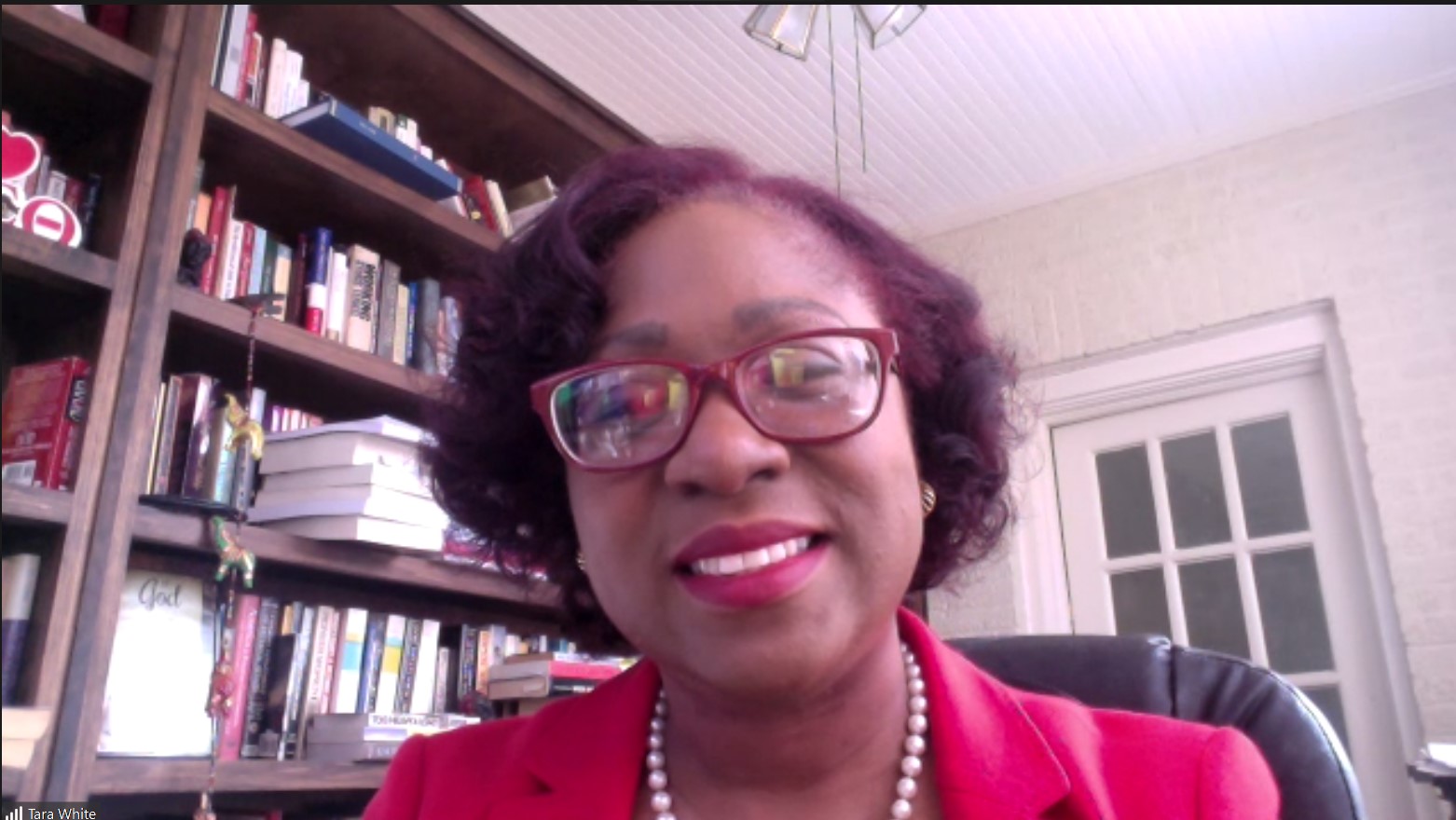
Dr. Tara White is an esteemed alumna of the Cooperstown Graduate Program, as well as a prominent historian in the fields of women's history and Black history. She was born in 1971 in Montgomery, Alabama, where she resides now. She is currently a professor of history at Wallace Community College in Selma, Alabama.
Dr. White graduated from the University of Alabama at Birmingham with her bachelor's degree in biology and chemistry prior to her time at the Cooperstown Graduate Program. She attended the program from 1997 to 1998, and received her master's degree in 1998, before pursuing a PhD at Middle Tennessee State University. She is a member of the Cooperstown Graduate Association.
Dr. White's recollections of her time at the Cooperstown Graduate Program range from fond memories of her community in the program and in the Village of Cooperstown, to instances of microaggressions she faced as a Black woman, to observations about urban life versus rural life. Some of the most interesting moments from the interview were when she discussed some of the relationships she was able to build during her time at the program.
This interview occurred during the Covid-19 pandemic, and, as a result, I interviewed Dr. White remotely via Zoom. She was at her home in Montgomery, Alabama. Dr. White is a Southern lady, and as a result often uses Southern expressions, which I have kept intact. Her identity as a Southerner is a major source of discussion throughout the interview.
-
Transcription
-
TW = Dr. Tara White
MM = Megan McGee
[START OF TRACK 1, 0:00]
MM:
This is Megan McGee interviewing Dr. Tara White remotely on the Zoom videoconference platform. Dr. White is at her office in Montgomery, Alabama, and I am at my home in Milford, New York. It is Wednesday, November 11, 2020, and this interview is being conducted for the Cooperstown Graduate Program's oral history project, which is part of the Research and Fieldwork course. So Dr. White, could you tell me a little bit how you ended up at the Cooperstown Graduate Program, what that process was like for you?
TW:
[Laughs] Attending Cooperstown, or actually applying to Cooperstown was kind of a way to, it was curiosity, believe it or not. I had been a science major undergrad and actually had worked, ended up working at a museum, and I met Dr. Sorin just kind of haphazardly, and that's another story in itself, but anyways, she mentioned she was director of the program. I think she had been there, at that time, for like a couple of years. A year or two. She asked me if I was interested, and I was like, eh, you know, not really. Not really interested in history [laughs]. Or museums! Well, I love museums but I'm not really interested in history or museums as a career option. She said, “Well, just think about it.” It actually was the end of the year. It had to be end of the year some time, so November, December, in that particular year. And she said, “Well, we're going to send you an application packet. Just look at it. If you're not interested, just chuck it. But it's up to you. It's entirely up to you.” So I looked at the materials that she sent. Well, actually, Lanny [Langdon G.] Wright, Dr. Lanny Wright sent out all the materials because he was actually the person who was kind of leading that process at the time. And he sent the materials out, and I looked at them, and I was like, “Oh wow! This is really interesting, you know, museums as a career choice.” I never really thought about that, but I enjoyed the work that I was doing, and enjoyed working education and working public programs. But I really wanted to learn more about other aspects of museums. This kind of was an opportunity for me, and I just said, “What the hey?” [laughs] I sent in the application. I had an application going into the School of Public Health, actually. That was where I was headed, to do a master's in public health. So anyways, I said “What the hey?” You know, spread it out. And the School of Public Health, that was a shoo-in. I wasn't concerned about getting in or anything like that.
So anyways, they sent me the information back, sent me a letter back saying that I was selected for this interview. I remember getting ready for this interview in upstate New York, and it was February at the time. No, wrong, March. Because at that time we were doing them in March. It was March, and I remember because it was during the same weekend as Gretchen's daughter, Meredith's, birthday. And Meredith's birthday is like, a day before my sister. The sister whose house I was just visiting, believe it or not, she and Meredith were born like a day apart. Same year. So anyways, I went up. Really interesting weekend, really interesting people, and I came back really hoping that I got in. Because I loved what I saw. And I was thrilled on Sunday when, well, the person who taught material culture at that time was Dr. Deborah Prosser. So, Deborah Prosser called me on Sunday, and she said, “Hi! We were really happy to meet you, we would love to have you come and join the class this fall.” And I was just like, over the moon. Over the moon and really happy. And it was really, how can I explain this? I was excited. It was something new. Really new. Something really different. It was, I don't know, something I wanted to explore, because, like I said, I enjoyed what I was doing, and I wanted more of that. And so Cooperstown it was.
MM:
So what was it like moving to Cooperstown from the South? How different was it?
TW:
Moving to Cooperstown. Although I lived in Montgomery, I was from Montgomery, I was living in Birmingham, I think. No, I had gone back to Montgomery, and I came there [to Cooperstown] from Montgomery. Cooperstown was very different, of course. Very small town. People, the Village [laughs]. Very small town. People assume, when you're from the South, that all Southerners are rural people, and that is not necessarily the case. I lived in Montgomery. I lived inside the city of Montgomery, I'd been in Montgomery. And Birmingham was like, what, a million people, right? So a sizeable city. We were city folk. Although we had rural roots, we were city folk. My grandmother was born in the city. And her mother had a rural background, but again, this is like, think about, my great-grandmother was born during Reconstruction. Yeah, my grandmother was born in the '20s, early 20th century. But still, city people with rural roots. And I really came to understand that most people thought, you know, we all live in pastures. The secretary at the time, Betty Hoss, said to me, she said, “Oh, Tara!” She had this voice that kind of reminded you of Edith Bunker, right? No, seriously. No joke. If you ask other people, they'll tell you, she sounds like Edith Bunker. She said, “Oh, Tara! This should remind you of home, right?” And I was like, no! No, I've never seen this many cows in my life! [laughs] And like I said, although I'd been to the country, because my grandfather, my mother's father, was from this little town outside of Montgomery called Mt. Meigs. And so, as kids, little kids, my summers; my great aunt, my granddaddy's home house was still there, in the country. It was out in Montgomery County. We'd go to Mt. Meigs during the summer. I would go. Me, and my sister, Jimmy's mom, my sister and my brother. We would spend our summers when my great aunt would come home from Albany. I had a great aunt who had lived in New York City and then Albany, and she would come home and we would actually go to the country for the summer and stay with her and hang out with her. That was the extent of our country, our rural anything. Yeah. I had a classmate, fortunately, who was from Horseheads. God rest her soul, Maria Oswalt, and Maria taught me the difference between cows. “No, Tara, the red cows are meat, the black and white cows are milk, you know you don't” - yeah, okay. You don't mix them - the twain shouldn't meet. Like I said, city girl. But coming into this rural village, although we lived in the city, some of the ways of city people, because most of these people came from some rural area, or they had rural roots, some of the ways of the people in the Village were very similar to me, and felt very familiar to me. That part of the Village I enjoyed, that people were neighborly, and they spoke to each other. You might find tomatoes on your step, or Swiss chard, or squash or zucchini, or whatever, that kind of stuff, which is really rural in character. And actually did happen in my growing up. We had neighbors who had gardens, and they would share whatever bounty they had. A whole bunch of peppers, whole bunch of okra, whole bunch of whatever. That part of it was really warm and really put me at ease.
One thing that was kind of jarring, although I had been in settings where, I'd been in a bunch of settings where I was the only Black person in the room. What was kind of jarring for me the first semester - by the end of the first semester, it was like, you know. Besides Gretchen, and her family, and they lived in Springfield Center–inside the Village I didn't commonly see African Americans at all. And that became really weird. It's like, wait a minute. There are no, I mean like absolutely no Black people here. Every now and then I had to, I did leave town and go to some other places where I could see a diversity of people. Yeah. And although, the cultural context, you know, as a historian, I think about this, and a person who looks at culture from the museum standpoint, and cultures, it's interesting to be the only person. And I don't think white Americans really understand that concept, of being in a place and you're the only person who looks like you, and maybe may have had your experience. There are lots of experiences that are common to people, because we're all humans, but there are also lots of experiences that are common to people within cultural groups. And those are some of the things that you miss. So for most African Americans, even the ones in northern places. I would leave and go to - we had cousins in New Jersey, and so I would actually, on holidays, I would leave and go to New Jersey, and visit those cousins. But some of the same kinds of Southern traditions. My cousin would invite everybody over, and she would make this big dinner, and that kind of thing. That was something that was heartening. Going to the beauty shop [chuckles] and finding someone to do my hair was a deal, but Gretchen, thankfully, thank God, Gretchen was like, “Okay, I actually go to Albany,” so I would have to go to Albany to find someone, yeah, to find someone to do my hair. She had a lady named Ms. Vernell, who for many, many years did my hair when I was a student, and then once I came back to Cooperstown as a faculty member, she picked right up, and we just kept going.
MM:
Was there any other challenges that you are willing to talk about that you had to overcome as a Black woman, while you were in Cooperstown?
TW:
One thing that stood out to me, and I couldn't really process it then, because it was a very new experience to me. As an undergraduate I attended the University of Alabama at Birmingham, which is a predominantly white institution. African American students were probably about 18% of the population there, so you know. Being in a place where you are the minority. Now I had plenty of friends who went to college at HBCUs [Historically Black Colleges and Universities], and you know, of course, their experiences were different. And I was in science, so being in a place where I'm one of a few people in a class, right? Biology major, chemistry minor. That was not uncommon. However, being in a place where your ideas are taken seriously, and people expect you to have something to say. There were times where I had to kind of fight to make sure that my ideas were taken seriously. I remember vividly the very first week - I don't know if you guys are still doing the orientation week thing. So first years, you come in, and you do your orientation project, and whatever. One of the things we were doing was developing CGP TV, I think that was our project. We did a TV guide and whatever, and they were like, “How are we going to make the TV guide?” And I said, “Oh, yeah, I was always making flyers and creating things where I was, when I was in Birmingham when I was in college.” So I started working on some stuff, and I said, “Yeah!” I jumped in with both feet, and whatever. I had pretty much set up the design and whatever, and I had a classmate who was like, “Well, okay, so you set this up, I can take over, you can just go on,” and I was like, “No, why would I want to go on?” “No, no, you can go on!” There was an active, hindsight, there was an active - she was actively trying to push me out. I realized from the very first week that I had to continue to assert myself and place myself in the conversation and stay. There were people who minimized, in the discussions, you know, tried to minimize, and I had to kind of push back. There was one situation where one classmate just started yelling at me, and I was like wait a minute! Who the hell? But anyways, we got - he was good. We got him straightened out. I got him straightened out. He had some problems, but I helped him. I helped him. But anyways, as Black women, people don't always - you're very visible. And that's what's so ironic about this, you're always very visible, but there are some people who assume that you don't have anything to say, anything meaningful. And there are also people who want to make sure that they get credit for the work that you do. That's something that has always been, I would say, kind of, not just disheartening, but alarming. And that person did try to take credit for the TV guide, later, and it's like, no, you didn't do that. Remember I started that thing, and we went back and forth, and you - okay. But anyways, we have to continue to make sure that there's a place at the table. And the saying by Shirley Chisholm, that if you don't have a seat, you bring your own damn folding chair, that is really apt. That is really apt. I found that that has been the case most, or I'd say all of my career.
MM:
Could you talk a little bit about your community that you built at CGP, with Dr. Sorin and people like that?
TW:
Well, yes! And not all of my classmates were crazy. I mean, there were a couple of folks who were nuts, and yeah, I'm going to say that. They'll be mad at me for this, but I don't care. They know I don't care either. There were a couple of folks who kind of, you know. But I would say the majority of folks in my class were very nice people. People who have gone on to amazing careers, and who I respect highly as professionals, as museum professionals. I will say that. And many of them reached out, because again, we were from a variety of places. Really, like my friend Maria [Oswalt] who was from Horseheads, New York, a very small town in western New York, and had a very rural background. Whereas, I am from the South, and kind of, more of a city, urban background. And then there was another classmate who was from the Midwest, big town, well, urban center in the Midwest, and there were some Northeasterners, and they were wonderful people. And believe it or not, there are classmates who I still talk to, I still visit with. I stayed at their houses, know their children, you know, it's that kind of situation. Followed their careers the entire time, we've stayed in touch the entire time. And that's not just in my class. The class above me, and the class below me, wonderful people, wonderful people. I will say that. And people I'm still on touch with.
But not just that, folks in the Village. I attended, although I was raised Baptist, I didn't feel very comfortable at the Baptist church. And that was the truth. And that's a whole story in itself. I went to the Baptist church and I was like, oh hell no. No, I can't stay here, nope. Because they were uncomfortable! I mean, it was, as my classmate, George Collins, used to say, boy, they were [more nervous] than a long tailed cat in a room full of rocking chairs! Yeah, it was bad, and I was like, what in the hell - why are these people freaking out? I'm just sitting there, just trying to enjoy the service. But anyways, I didn't go back to the Baptist church. I did go to the Presbyterian church, the Presbyterians were so wonderful. Oh God, they were so wonderful. In fact, when I went back, I went back to the Presbyterian church, and I enjoyed them so, so much. They were lovely people, just warm, and kind, and I can't say enough for the Presbyterian people. I can't say enough about them. Good people. Went to the Methodist church, too, eh. But Presbyterians, they were wonderful folks. And so I found community in my church. I found community in people I knew from the Village.
I found community with some of the faculty. I got to know people very well. I ended up having a project my first year because I knew I was interested in doing oral histories. So Gretchen set me up with Dr. Bruce Buckley. Dr. Buckley invited me over to his home, I got to know his wife Mona, and we would sit and he would do class in his den, right? And Mrs. Buckley would make us lunch, and it was wonderful, an entire semester. And at the end of that semester he died. And that was tough [voice breaking]. It really was. But he and Mrs. Buckley - even after he died, Mrs. Buckley continued to - every time I visited, she always rolled out the red carpet. When I got back to town, I got a chance to visit with her. Just so many just really wonderful people. Anyways, I'm sorry I got all misty eyed, but they were really great to me, and I learned a lot in that one semester with Dr. Buckley. I still do oral history to this day. And I will say that I learned a lot from Dr. Buckley, and I'm eternally grateful for that.
MM:
Were there other professors that meant that to you, in your other years?
TW:
Oh! So, let me see. Deborah Prosser, who taught [laughs] women's history. Well, she taught material culture and decorative arts. And what was funny was that I would always chide the decorative arts people. It's like, you know, the furniture and dishes people, right? Because I was serious history, and those furniture and dishes people, right? So anyways, my last semester, she said, “Tara, do not ask me for a dec arts job recommendation, [laughs] because I'm not going to give it to you. Because you're always saying those furniture and dishes people!” Well, anyways, I took a class with her. Actually, women's history through material culture, which was wonderful. And introduced me to women's history, which that's one of my fields now as a historian. So I did reach out. And every now and then, she'll hit me up. Believe it or not, she'll email me and say hello and whatever. She's now in Georgia of all places! Yes, I know. People come to the South and they love it and they stay. They do. They swear they'll never come South, and then they come and they fall in love and they stay. And that's what happened. But anyway, she was wonderful to me, and in fact, I did take a dec arts course, and did well, and she's like, “Tara, I just was really surprised [laughs] and impressed, so you can get that dec arts recommendation after all!” But I never applied for a dec arts job. I appreciated it, but no, that wasn't what I wanted to do.
Paul D'Ambrosio, I spent plenty of time with Paul, and got to know Anna [D'Ambrosio], because we would take a bunch of trips over to, we called it the Monster-tute, over to Munson-Williams-Proctor. And Katie Boardman, because I did interpretation. Well, I started out in education and public programs, and did tours and that kind of stuff. So Katie and I were an instant hit, and she really taught. Well, it's one thing to learn on the job, it's another thing to understand the theory and practice of interpretation, and Katie really gave me that foundation, so I appreciated that. Stayed in touch with Katie for years. In fact, we co-authored a piece some years ago. Who else?
Of course, of course Lanny Wright. Lanny [sighs]. Now that was one, that's another one. Lanny was, he was grouchy as hell! [laughs] If you came in and asked Lanny how he was doing, he'd say, “Wretched,” and you knew he was good. He was drinking coffee every morning, so there were mornings where I'd actually go and get my cup and I'd drink coffee with Lanny. Because I was there. My assistantship was the photo lab, so I was there working in the photo lab, either developing stuff, or making sure things were straight in there, cleaning it up, or ordering supplies, or developing my own film. I was always running into Lanny. He was really good. I learned historiography from Lanny in a way that history made sense to me. He encouraged me to continue. And that's another thing that I appreciate to this day. Him encouraging me, “No, Tara, you really could go on, and do a PhD.” He really pushed and encouraged that. So I appreciated that. But Lanny was great.
We had Tim Toff, who used to clean the building. Tim was a hunter guy, so Tim liked getting out and hunting. And in fact, what was also funny was the Biological Field Station people downstairs. I don't know if that's - are they still downstairs?
MM:
Yes.
TW:
Okay, they are still downstairs. Well, my classmates were always freaked out by the jars of dead stuff downstairs. Now, I was a biology major so that was par for the course for me. It's like, oh yeah, you know I'm not really into poikilotherms, the reptiles and stuff. Because I'm trying to remember whether he was - no, he did marine stuff. But anyways he - they had all kinds of stuff down there. There were a few living things. I think they had a turtle, some turtles, and some other stuff. But anyways, my classmates were always just like [gags] turned off. I loved it! It gave me the best of both worlds. I still missed the science, so I would go down there and kind of piddle around, and they were like “Why you up there with those people?” Yeah, right? “Why are you up there with those people? Oh my God, you don't belong up there, you belong down here with us! You're one of us!” So I'd go down there and hang out with them sometimes, and that was really good. When I came back - well, actually this started before I left, and then - before I finished Cooperstown, and then when I came back as a faculty member, it just picked right up. So, they had these roadkill lunches. That's what Gretchen called them [laughs]. She swore that they'd just pick up any damn thing off the road and cook it. Now, truth was, sometimes it was some stuff from off the - yeah, no lie! If somebody hit a deer they were like, “Man, that was a nice deer. We salvaged what we could, and we brought the rest of it,” and I was like, aw, hell. But they boiled it real good, and killed whatever, and we ate lunch. But they were a great group of guys [laughs]. They were a great group of guys. I loved hanging out with them. Tim was an amazing, wonderful, kind-hearted, really gruff but had a heart of gold. He would bring us deer sausage every year. The deer sausage, it was wonderful [laughs]. He was amazing with the deer sausage.
But just like I said, a building full of good folks. Betty, Betty was just Betty. Betty was Betty, that's all I'm gonna say, bless her heart. Initially, there was just Betty, and then when I came back, Rosemary [Craig]. Oh! Cathy [Raddatz]. Cathy was there when I left. And Cathy has always been -what else can I say? I got to know Cathy and Don [Raddatz] well, before I left, and their kids. And when I came back, picked right back up with Cathy and Don. Don and I are Facebook friends, actually. He helped me out in a couple of really big pinches. Bone pinches. But they just really - Cathy has an amazing sense of humor, and she is just kind and nurturing, Cathy is. And she's always been that way. But an amazing resource person. She knows everybody, for real. She really does. So that was a big help when I was looking for - the first time, just as a student, we're all trying to navigate. But she knew the people in the Village, and she would send us to this person or that person. And this was all of us. Cathy had a knack for being able to do that. When I came back as a faculty member, Cathy knew, okay, you need to go to this person to get your taxes done, and this person to, it was that way. That was really wonderful. And I'm trying to remember who else would have been in the office at the time. Geri [Erwin] and Ann [Stewart] were later. Ann Stewart, God rest her soul - I don't want to start crying again. I loved Ann, and that's all I'm gonna say. I knew her father, and one of the reasons I ended up in the photo lab was because I was interested in photography. And Milo, her dad, and Frank Rollins were the people teaching photography. Mr. Rollins was, he was a hoot. But yeah, I got to know Milo well during that time, and Mr. Rollins, because I was really interested in learning how to really take pictures and do well with that. Who else was on? All of the faculty I think are different people, because Lanny died, so we had a couple different folks. The other person was–come on, Tara–the other persons were C.R. Jones, who taught half of the collections, and then Bruce MacLeish taught the other half. But both of them were, they were both great folks. C.R. and Bruce also were good Presbyterians, so I'd see them on Sunday.
So just a bunch of really wonderful people. Really wonderful people, and I tell you, I learned a lot. Learned a lot. Enjoyed the time I spent. It was a complete shift for me, because like I said, I had gone to school to do, my degree was in biology and my minor was chemistry. Chemistry and Spanish, actually. This was just a whole new world. But I ate it up, because I was just really excited about what I was learning. In some instances, learning the theory behind the practice, and in other instances just completely learning something new, because the collections stuff was new to me. That was completely new to me. And later on I was able to add to that, because I ended up doing some work in archives as well. Being able to understand what it was, was good.
MM:
Tell about when you came back. What it was like, when you came back as a faculty
member.
TW:
When I came back as a faculty member - you know, it's funny. As a student, you see the world in one way. Being on the other side of the table, like during Interview Weekend, it's completely - I remember, I was so scared! Oh, my goodness! And that's normal! That's really normal, to be nervous. So, on the other side, we had to reassure students. Students were flipping out, and it's like okay. I need you to just take a breath, and calm down. Calm down. Right before my second interview, I had an entire accident. Yeah, no joke. Car ran off the road, tore up a couple - took out a couple of signs and small trees, yeah. Tore up the rental car, it was, yeah. So I was the good person to kind of calm people down, and get them together, and that kind of stuff. It was wonderful to work with such a dedicated faculty. People don't realize how much work they do, oh God! [laughs] They do a lot of work. They work very hard. They're really dedicated.
I was able to actually meet Cindy. I had heard of Cindy Falk, and in fact one of my friends, she was in the class behind me, Jane McCone, Jane ended up having to take over her field trip because Cindy went into labor early with Isaac. Yes, right? The Philadelphia field trip! So she had to leave and have the baby, and Jane had to come kind of take over her field trip, and you know, kind of take over for a bit for her, while she cared for the baby. She went in much earlier than she expected. So I got to meet Cindy, and got to know Cindy and Glenn. Wonderful, oh! Anyways, I spent a lot of time with Cindy and Glenn. But, like I said, Rosemary, getting to know Rosemary, getting to know Geri.
In fact, Geri and Ann and I, they took me around, and we went up looking for food, because they knew as Southerners, we have a love affair with food. So they took me, oh, my goodness gracious, over into Utica, and Rome, and we ate, oh my, oh! And took pictures, because I think she was looking for churches, and whatever and so we had to go over to this church and do some stuff. And we went out, I mean we went to a couple of different places and had food. It was amazing. Of course, I'm ruined for Italian food, I can't eat any in the South anymore. It's just straight garbage. It's garbage! But it was a wonderful field trip for us, and wonderful experience. And like I said, Ann and Geri just are wonderful, wonderful ladies, and I really miss Ann. I really do. Like I said, got to know not just Ann, but Milo, and her mom. Her mom [Ruth Stewart] did some framing for me for a bunch of stuff that I have on my walls now. Got to know Ann, got to know Russ [Honicker]. [laughs]. Got to know her son [Weston], oh my goodness! Her son, he was a really neat young man, you know? And she was a neat lady.
The second time, like I said, a lot of work. I learned a lot about teaching and students [laughs]. Students were different! Gen Xers, we usually, we'll just slog up the hill. We'll take it on the chin, you know, we don't complain. You just give us extra work, we'll just [sighs] okay, you know? And we do the extra work. Man, these kids would complain, “Oh my God, all this reading! This is so much reading!” It's like what the hell are you expecting, this is history! Anyways, we were, yeah, we were. But, there were some really good students. Really good students in that class. I got to know those students in the class that I was teaching, and the students in the class above. And of course I interviewed the students who came into the next class. I'm still connected to a bunch of the students in the second-year class. In fact, one of them - well, let me see. Second-year class. I'm still connected to a bunch of them, believe it or not. A bunch of them I see and kind of hear from.
I'm really involved with public history, and no joke, went to my very first public history conference at Cooperstown! NCPH met in Albany my second year. And Gretchen took all of us over. And so that was my introduction to NCPH and to public history. I've been involved with public history ever since, believe it or not, as a member of NCPH. I'm an active public historian.
Stephanie Rowe, oh, she was Stephanie Lehner, then. She was a second year. She's now the director of NCPH. So I'm just really, really proud of her. And like I said, I keep in touch with a bunch of them, from Kimberly Springle, to Stephanie - I see Erica and, oh. She's out in Washington, all the time. Online, we kind of keep up. Just a bunch of folks. They were really neat students. And my class! My class. I mean, you know, I still keep in touch with students from my class. From the class that I taught. Yes, and I've seen them go on and get married, and have kids, and that part has been amazing to see them as parents, and to grow in their careers. They're doing very well. Erica Freeman loved to joke about working at the prison, but she's doing very well! [laughs] The Eastern site, the historic site, she's done amazing work there. Janet Agin, that's her name, Janet at BIA [Bureau of Indian Affairs]. She didn't think she would like collections, and we were like, you'll like collections. And she likes collections. Just a bunch of them, they're doing so well. I'm very, very proud of them. Very proud of them.
MM:
How would you say that your time at CGP really shaped you as an emerging museum professional, and as a museum professional today?
TW:
I think that the main thing I will say about my time at CGP, and the strength of Cooperstown is - well, two things. The first is that the generalist program, and the way they exposed us to just about everything means that when you walk on the job, you're not like, oh crap, what in the hell is this? No, because you've seen it before. So that gives you a sense of confidence, that basically there's not been much that you've not seen. Seriously. That's the first thing.
The second is the hands-on experience. Having actually worked on collections projects, oh, man. I remember when we first got there, and we had those things that we had to actually do collections. Just go through the process with - so, everybody got an object, and you had to actually accession this object, and research this object, and whatever. I ended up with a plane. Now, I didn't know what the hell planes were. I was like, what do you do with this thing? What the hell is this? Anyways, I ended up with a hand plane. I came to understand that they were used to [laughs] - they were used to actually plane down wood. And all of these wonderful, I guess, styles in furniture and furniture making. And not just in furniture making, but in just wood as well. These planes did that. So you had some really strong man who's pushing this plane along a plank of wood, and carving out all this wonderful stuff, like this molding in my 80-year-old house, right? Some of this was machine done, but there are lots of places where I see that a lot of this has been hand planed. So all these years later, I get it. But at the time I was like, this is dumb. This is crazy. This is kind of nuts. Later on I understood that you needed to understand the process for doing this, how this object was created, and what it did and whatever, in order to understand its function, right? But that process made me learn a whole lot.
Being voluntold for all kinds of stuff. Now, you guys didn't have the Harvest Festival, you didn't have the - oh, man. Was it the junior rodeo thing [Junior Livestock Show]? The horse show, rodeo thing. Oh, my goodness, all of these tours, the school programs over at NYSHA [the New York State Historical Association], yeah. [laughs] We had a lot of opportunities for hands-on learning. And they were invaluable, because we showed up on jobs able to do, and not just talk about it, right? And that's the Cooperstown difference. What was amazing to me was later on, when I went to my PhD program [at Middle Tennessee State University], the director for the Center for Historic Preservation at Middle Tennessee State, has patterned his program at the Center after the Cooperstown program. He had a couple of students who came through in years past who were from Cooperstown. And that hands-on, right, experience he realized was the game changer. That was the compelling difference. And so, he told me! He said, “I was so happy to see you and know you were from Cooperstown! I know that if you were from Cooperstown you came here with something. Because that hands-on model, you were actually doing something.” And I was like, “Well, yeah, we had to do a bunch.” And he said, “No, but that means that it's not a theoretical with you. You actually know how to do the work.” And I was like, “Oh! Okay, yeah.” And he did, he patterned his program just that way. So we have influence in the world. We do good work. And there are so many other places where - one of my classmates did [the program in historical administration at] Eastern Illinois with Debra Reid. And of course, she was a Cooperstown graduate as well, and same thing. That hands-on, practical experience is what makes a difference with students in this field.
MM:
So we're nearing the end of our interview segment here, so I'd like to ask you a reflective question. If you were to give advice to current or incoming students at the Graduate Program, what would you tell them?
TW:
My advice to current students - well, yeah. Current or incoming students. I'll start with current students. Current students, just do the damn reading. Don't complain about the reading. Do the reading! Because you're going to come across some of this stuff again, do the reading. The second thing is to go out and as many opportunities as you have to do, or have show up in front of you, jump on those opportunities. You want to do, and learn to do, as much as you can, because this is a laboratory. There's an opportunity to learn about just about everything. Use this time to do just that. Thankfully, not only was I able to learn there, I ended up interning, my summer internship was at the Smithsonian American History Museum, and I learned more about working on exhibitions. There was Lonnie Bunch and Spencer Crew, and it was an amazing experience. Who knew Lonnie would go on to be the Secretary [laughs] over all of the Smithsonians? I really enjoyed working with Lonnie, Lonnie has been an amazing mentor over the years. Spencer also. I've ended up doing a bunch of consulting work. That's the other thing that people will do, they'll send consulting work your way, so I've gotten a bunch of consulting work and consulting projects. People call me up and say, “Lonnie Bunch, Spencer Crew told me to call you.” Some projects, I'd take some projects. I'd take some of them. But do as much as you can, you know, do as much as you can, learn as much as you can. The things that you think you might do now, you may end up doing something completely different later, so you want to know a little bit about everything. If you end up in administration, of course. The beauty of having done Cooperstown is, you know. Well, I had already had accounting in college because towards the end of my college career, I thought I was going to go and work in administration in hospitals. So I'd taken accounting, but learning how to do financial statements, right, and to read financial statements. Understanding development, that has been invaluable in my career. And not just in my career, because there are other opportunities, other places where I'm working with nonprofits, right? So consulting with nonprofits. I'm a board member, right, with nonprofits, and I bring that experience, those experiences, with me, twenty-something odd years later. So as much as you can get involved with, as much as you can learn, use this time to learn. Use this time to get involved with as much as you can. Use this time to get to know people! Get to know your classmates, because that's the other thing, and other people in Cooperstown, in the program. I have leaned on I don't know how many Cooperstown alumni, right, later on, while I was out in the field. When I started working with historic houses, I was able to call up - well, did I have any? I didn't have any classmates working in historic houses when I started, but now, we kind of understood Fenimore House is a house, right, so some of the challenges that go with a historic building. But I had classmates from the second years, who were working in historic houses in different places. They were sending me all kinds of stuff. Make friends, learn people, get to know folks. People have called me in on projects, I've called them in on projects. It becomes a wonderful, welcoming, just amazing thing. And like I said, you never know if you end up working with your professors. I have worked with, I have ended up working on grant committees. Believe it or not, Gretchen and I were on a couple of committees together. I've been on stuff with Paul. Like I said, Katie and I co-authored a piece together. Just don't limit yourself. Don't limit yourself. And see this as an opportunity to build, because this is a good foundation. Cooperstown is an excellent foundation. I continue to send Cooperstown money. Cooperstown gets money when other people don't get money. Cooperstown can call me and say, “Tara, we need x number of dollars, can you give us x number of dollars?” And I'm looking for the money, because that's how valuable my CGP experience was. Get to know people, make friends, they follow you thirty, forty years. I'm not at the thirty, forty years–twenty! Definitely twenty. Twenty-something. But twenty-something years later, I'm still calling those same people. I'm still calling Cooperstown grads. I'm still working with CGP. I'm working on a project in South Carolina. One of the people I'm working with, CGP, you know? And it's a known quantity. You know what kind of - you know the quality of the work they're going to do, if you work with them. And that's the truth. And that's the reputation that we have in the field. When we walk in the room, people know the quality of work that they're going to get from us. And that's a good feeling. That's a really good feeling. And of course you have to do the work to live up to it, but yeah.
MM:
Well, thank you for your information, and your time. This is going to conclude our interview. Thank you for your valuable information and time. We appreciate it.
TW:
No problem, thank you. Thank you.
[END OF TRACK 1, 1:02:16]
-
Coverage
-
Upstate New York
-
Cooperstown, NY
-
1971-2020
-
Creator
-
Megan McGee
-
Publisher
-
Cooperstown Graduate Program, State University of New York-College at Oneonta
-
Rights
-
Cooperstown Graduate Association, Cooperstown, NY
-
Format
-
audio/mpeg
-
57mB
-
image/jpeg
-
189 KB
-
Language
-
en-US
-
Type
-
Sound
-
Image
-
Identifier
-
20-012
-
Abstract
-
Track 1, 00:36 -- Application process
-
Track 1, 06:00 -- Rural and urban life
-
Track 1, 11:26 -- Black identity
-
Track 1, 20:27 -- Community
-
Track 1, 31:20 -- Biological Field Station
-
Track 1, 43:37 -- Teaching
-
Track 1, 48:19 -- Strengths of Cooperstown Graduate Program
-
Track 1, 54:47 -- Advice to current students