-
Title
-
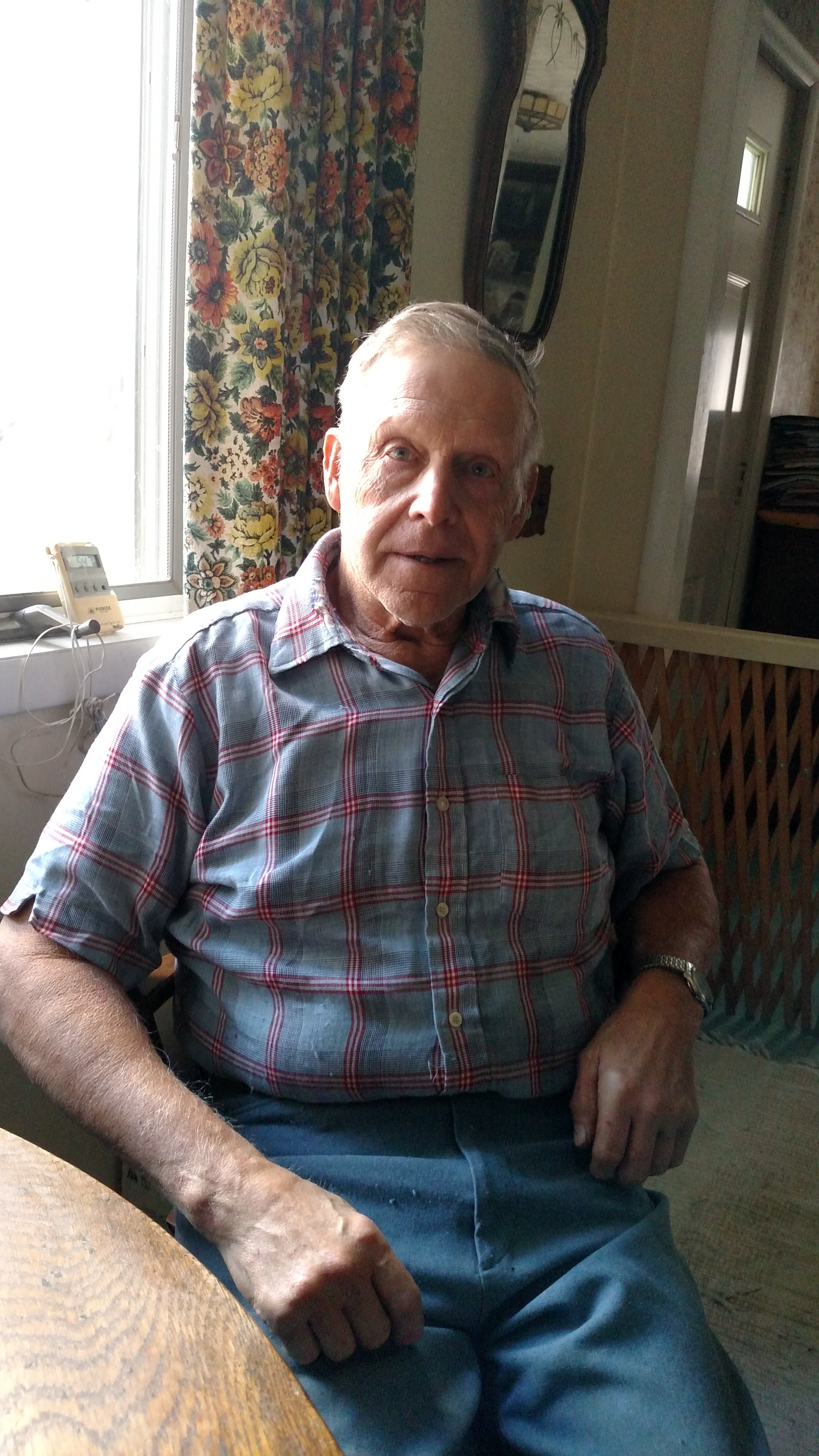
Richard Rathbun, November 11, 2015
-
interviewee
-
Richard Rathbun
-
interviewer
-
Luke Murphy
-
Date
-
2015-11-11
-
Subject
-
Farming
-
US Route 20
-
Firefighting
-
Small business disappearance
-
Local governance
-
Description
-
Richard Rathbun is the descendant of a long line of farmers that have worked in Springfield, New York for centuries. His ancestor, Benjamin Rathbun, bought the Rathbun land (where Richard currently lives) from the Clarke family in 1788. Richard was born at Bassett Hospital in Cooperstown in 1941. Since then, Richard has lived his entire life in Springfield and has had a very active presence in the town. In addition to farming, Richard has served with the Springfield Fire Department for the past fifty years and has served on the Springfield town board for the past thirty years.
During Richard's lifetime, the United States has witnessed an enormous shift in agricultural practices. The growth of large farms after the Second World War made it much more difficult for small, family-run farms to compete. As a result, many families have sold their farms. Another major shift witnessed by the United States occurred in the 1950s with the introduction of the Interstate Highway System. Before the development of the Interstate in the 1950s, many small businesses existed along U.S. Route 20, which served as a major route crossing the United States. With the development of the Interstate, however, many of these businesses lost customers, as much their traffic was redirected towards the Interstate.
Richard's recollections of Springfield's past and the state of farming as well as U.S. route 20 entail both regional trends that he often times parallels with what is occurring nationally. A particularly interesting part of the interview occurs towards the end of our interview when Richard describes the effect small chain stores, such as Stewart's Shops and Red Apple, have had on small businesses in the area.
I interviewed Richard in his family home, located in Springfield, New York. In my pre-interview with Richard, we mostly discussed his family's long history with farming, so that was the major topic of our interview. However, we also spent a significant amount of time talking about U.S. Route 20, his experiences as a firefighter and local town board member, and some of his views on renewable energy.
Richard gave very detailed answers. For the sake of readability, the transcriber took the liberty of standardizing syntax and grammar that may not correspond verbatim with what was said during the interview.
-
Transcription
-
Cooperstown Graduate Program
Oral History Project Fall 2015
RR= Richard Rathbun
LM= Luke Murphy
[START OF TRACK 1, 0:00]
LM:
This is the November 11, 2015 interview of Richard Rathbun by Luke Murphy for CGP Community Stories, recorded at Mr. Rathbun's home in Springfield, New York. So Richard, where were you born?
RR:
I was born in Cooperstown, at [Mary Imogene] Bassett Hospital, 1941.
LM:
And how long has your family farmed the area?
RR:
Well, the original family has been farming here since probably the late 1700s, but my immediate family, my father, Dean O. Rathbun, started farming on this particular place around 1923. I told you 1929 before but I think they started around '23. He married my mother in '29, and he bought [the farm] from his father, George B. Rathbun.
LM:
When did your family come to the area?
RR:
My family ancestors came to the area back in the late 1700s. And, other than that, we've always lived in the area. I mean, I was born and raised on this farm–or born in Cooperstown, raised on the farm–we've been here for generations.
LM:
What type of farming have you and your family participated in?
RR:
It's always been dairy farming. We had registered Holsteins right up until the time the herd was sold in 2006.
LM:
Why was the herd sold?
RR:
Old age [laughter]. It was time to retire.
LM:
What was it like growing up on the farm?
RR:
Well, you really couldn't ask for any better life. You learn work ethics and how to get along with your neighbors and so on and so forth. It was just a good life over all.
LM:
Would you mind going into a little bit more depth about why it was so good?
RR:
Well, you work with the land, you work with your hands and it was a family orientated business. Your father showed you a lot of things, as far as running a farm goes and what you carried on later on in life, that you wouldn't ordinarily get anywhere else. Just, a very good life experience.
LM:
Concerning farming today, especially when considering the past, is there anything that concerns you about the state of farming today?
RR:
Well, it's awfully hard for anybody to want to get started in farming today, that's for sure. The cost of everything; your land tax, your cost of machinery, the cost of cattle. You go by a pasture and look at a cow and you don't think too much of it, but actually a cow will run you anywhere up to $2,000 on up. A person has to have sixty, seventy, eighty [cows], and that adds up. Plus buying the farm, plus buying your equipment in order to operate.
LM:
How many head of cattle did you have at the peak time?
RR:
Well, we were a small farm. We milked thirty-eight cows and then we had about thirty-eight head of young stock females at various ages which were the replacement for the herd. We had what they called a closed herd. We never brought any female animals in.
LM:
Could you describe a little bit what a closed herd would be?
RR:
Well, that's it. A closed herd is one where you don't bring in other female livestock. You use bulls from the outside and artificial insemination. But, we raised our own replacements and we didn't buy any replacement stock off the market or anything like that.
LM:
In your youth, how much of your day was spent either working or doing farm related activities?
RR:
Well, during my youth it wasn't that demanding, only on Saturdays maybe and nights after school we had our jobs to do. Other than that, you're going to school during the week. During the summer time you helped with the haying and helped with the crops up until school started in September. Then it was the school routine plus some jobs you had to do like make sure the wood box is filled in the house and maybe gather some eggs or something like that but you always had school work to do too so. My mother was a teacher. She taught school for forty-two years.
LM:
Yeah, I was going actually going to ask about your mother. Did your mother help out a lot around the farm?
RR:
Not so much on the farm because she had the household duties to do and she taught school, so that was her full-time job right there. She prepared meals for the men during the summer time when she wasn't teaching school but [family was her first priority].
LM:
Where did your mother teach school?
RR:
Well, she started out in a one-room schoolhouse down in Oaksville, near Fly Creek. And then when she married dad in 1929, she worked in the Springfield school district. There used to be a little school house over on the other side of these woods and there's a sign over there now, a historical sign. She started there after she married my father and then after that [the district] built the school in East Springfield around 1939. And then she went to [teach] school there when they opened that one up and closed some of the small, rural schools. She got her degree at Oneonta Normal [School] years ago.
LM:
Where did you attend school?
RR:
I attended school in the Springfield School system and then I went to Cobleskill Ag and Tech for [two] years with an [AAS degree] in agronomy. Then I came back to the farm.
LM:
When did you decide to continue working on your family's farm?
RR:
It was kind of an obvious choice, because I had done it all my life and when I graduated from high school, I wasn't quite ready to go anywhere to college and I stayed home and worked a year on the farm. Then, I went to Cobleskill for a couple years and then my father needed some more help, and I fit right in. I had already had some livestock of my own here on the farm.
LM:
Could you tell me a little bit about your college experiences, if, for example, you enjoyed it or–?
RR:
It was a good experience. I have two older sisters; one was a nurse and she went to Plattsburg and became a school nurse. I had another sister who started out at Oneonta State then and got married and she finished her degree in New Paltz, a teacher's degree. So, I was exposed to college all the while. My father, years and years ago back in the early ‘20s went to Cornell and they had a short course on agriculture, I think it was a year or something like that. Then, after that, he went to Albany Business School and that was another short course, I think also for a year. I don't know exactly. Of course, my mother was always a school teacher and she had college experience with Oneonta State, well it wasn't Oneonta State back then, but Oneonta Normal. So I was always exposed to it and the experience, I would recommend it for anybody, really, even if they don't last a semester or so because, the variety of people you meet. It gives you a good cross-section of what's out there. My mother and father were always goers anyway. They took trips when they could. Of course, you always had the farming, [but] we weren't confined to the farm, I mean the family was pretty outgoing.
LM:
So you said that your family took some trips. What is a fond memory of a trip you went on?
RR:
Well, it wasn't so much with us kids [as it was just my mother and father]. Somebody had to stay home and do the farming. But they, years ago, I don't know if they if they do it now or not, but American Agriculturist Magazine [offered to send] them on trips. They went to Hawaii, the World's Fair out in Seattle, and they've been to Alaska. Most of the traveling I've done was pretty much on my own or connected with farming after that.
LM:
Switching it up a little bit more towards the present, what have working conditions been like since the economy to decline in 2007, with the so-called Great Recession?
RR:
The working conditions on the farm never really change. The cows have to be milked, the fields have to be tended and the crops have got to be tended to and so on and so forth.
[PHONE RINGING. RECORDING PAUSED AT 10:28]
[RECORDING CONTINUED AT 10:28]
LM:
Okay. I'm sorry, I'll go back and re-ask that. So you said that working conditions–
RR:
Oh yeah. You always have work to do. The cows have got to be milked and you've got to get your crops in for winter feed for the following winter. You have a lot of manual labor and no matter how much you modernize–[though] it helps to some extent–there is still “X” amount of manual labor that you've got to do, and you've got to be there to do it. You've got to stay on top of things, it's a business. It's not a game, it's a business. It's your survival. Either that or you better find something else to do [laughter].
LM:
So you said that you've grown up on this farm, this land as a matter of fact. What was life like living near [U.S.] Route 20 before the [New York State] Thruway [was constructed] in the 1950s'?
RR:
Back in the days when I grew up there were a lot more gas stations in East Springfield. There was a big general store up there where you did quite a lot of shopping. [U.S.] Route 20 was the main thoroughfare across the United States and well, the traffic was quite busy, but there again, you don't have the traffic you have nowadays anyway. The Thruway did eliminate quite a lot of it when they built in but, there again, I think there is just as much traffic on [U.S. Route] 20 now as there was back when I was a kid, or more as far as that goes. What you lack [now are] the little gas stations and the, well like I said before, there was a general store in East Springfield and I remember as a kid there was an awful lot of small motels around, too. There were little units [that] have all disappeared. And then there was several hotels around Route 20 too, but they pretty much disappeared, but the landscape in general has just changed.
LM:
Now when you say in general, would you mind telling me about the other ways the landscape has changed besides loss of hotels?
RR:
Well, along [U.S. Route] 20, there were a lot of dairy farms too, at one time and they pretty much disappeared. If you do happen to see one, it's a lot larger than what they've ever been before. But, the old hotels and gas service stations are now empty lots over around Sharon Springs. Beyond Sharon Springs there's a few old buildings just standing there along [Route] 20 and it's obvious that's what they were, but they are not being used. So you either have an open lot or you have, maybe the main place, the main house that went along with the motel. The little units, are all gone but they've rebuilt the house and modernized the house and somebody lives there.
LM:
Would you like to discuss any of the positives that came through with the introduction of the Thruway?
RR:
Well, it's hard to say. The Thruway is, from here, twenty miles away and it really didn't affect us, myself per se or my family, because, that was another whole different adventure to go to Fort Plain or Canajoharie as far as the Thruway goes. The big event around here was back in the early ‘50s, when they took Route 20, from East Springfield to over beyond Cherry Valley, and they rebuilt it. They straightened it out, and it bypassed the village of Cherry Valley. The construction equipment and everything like that was quite a deal to see. Around the same time, in the early ‘50s, they put a pipeline through. That was quite an event too, to see that machinery and all the blasting that took place, going through the rock above East Springfield.
LM:
What was being pumped through the pipeline?
RR:
Natural gas. Oklahoma to Albany, I think. Or farther. Or maybe even Houston, because I had a friend of mine that worked for Tennessee Gas and at one time he operated the big pump station out by Esperance. I think he had to call Houston about every hour to relay pressure.
LM:
How did the pipeline affect the local economy in the 1950s?
RR:
Well it didn't affect the local economy other than government. The pipelines paid tax on the land the same as any other utility. It isn't something you can lay your hand on, but there was money going in the coffers of the town from tax money from the pipeline. Because, as far as the pipeline goes, it was just a distribution line. There were no feeder lines off of that to the villages around here so, you know, it was just there.
LM:
Now you said the town gained some revenue from the pipeline. Can you talk about if the town used that for any particular things, or–?
RR:
No, it all goes right into the general tax money. It goes to the county first then comes back to the town. You can't put your hand on “X” dollar that came from the pipeline. It's the same as anybody else's taxes, it goes to the coffer. All the town tax money is all in one big chunk, and it goes to the county, then the county distributes it back to the towns. You can't say this is my dollar, or that's their dollar.
LM:
Kind of switching gears again a little bit, I was hoping you could talk some of the big changes in farming you've seen over your lifetime; the changes in agricultural practices or farming in general.
RR:
Well, most of all the farms have gotten bigger. In my area, it used to be that almost every farm around here had some dairy cows. Now, they've sold it to somebody else for a bigger farm. What I've noticed mostly in town now too, especially on the East Springfield side, is an awful lot of land being bought up just for crop land and no dairy at all. Over in Springfield Center, there is one big farm over there, Waterpoint Farm, they've got an awful lot of land. But specifically, there are two or three farms out in East Springfield that were sold in the last two years that's strictly for crops, for soybeans, and for corn.
LM:
So the farms are getting bigger. How are they managed? Is it still family run or is it more–
RR:
Some are and some aren't. Two of them might be corporate farms, most all of them are family farms. And by family farms I mean you're getting down to father, son, and grandchildren running them. It used to be father and son.
LM:
Your family has been here for multiple generations. Could you describe some of the relations you had, if you had any, with any other farm families in the area?
RR:
Years and years ago, when it came crop time, you helped other farmers. There was usually a group of three or four in your immediate area. You got together and you got the grain harvested, and you helped put the corn in, and you filled the silos. But other than that, you all pretty much did your own thing, because, that was a full-time job. It did work out good when you got together in the fall and the late summer, in August, something like that. You'd do the threshing of the oats and then in the fall, put the corn in the silo, because, as I remember, when I first was able to get around a little bit, maybe seven or eight years old, everybody pretty much had a team of horses around. A lot of it was done by horse. There were tractors, don't get me wrong there, but the horses hung on for a while too.
LM:
Until about what year, would you say, with the horses, did they stick around for?
RR:
Oh, I'd probably say maybe up to '49 or '50 and then you didn't see them so much. Everybody pretty much had tractors after that. They still might have had the old team pastured out somewhere nearby bye, but other than that, it was just there. A good team of horses was always part of the family just like your dog was too. They didn't just sell it because they weren't useful. Most of the old teams lived out their lives on the farm that they worked on.
LM:
Did your family have horses?
RR:
Oh, yeah. I remember back, oh, it must have been 1945-46. That was the last time we used a team. But, then we had an old horse around for quite a few years after that by the name of Ben. He used to be pastured out here, in what we call the orchard, next to the house here. When we were kids, we used to ride him. Then, when his day came, that was the end of Ben.
LM:
How long was Ben in the family for?
RR:
I couldn't tell you. I don't know just when my dad had that team. He had a team by the name of Ben and Betsy, but, when he bought them, I do not know.
LM:
It's really a nice opportunity to be talking with someone who's lived in the area for most of their life. Could you talk to me about a particularly fond memory you have of the area; of Springfield or Cooperstown that sticks out in your mind?
RR:
Well, other than working on the farm, my aunt owned a resort down on Hyde Bay. We used to get done with work at the end of the day and during the day when things slowed up, we would head to the lake, and jump in the lake and that was real handy. Yeah, the state park [is nearby] there–I don't know what it's called there right now.
LM:
Glimmerglass, maybe?
RR:
Maybe…just a short way below the state park…Otsego Colony or something like that. I don't know. But yeah, that was a resort on the lake that was owned by my grandfather years and years ago, and then I had an aunt and uncle who bought it from them and they had a resort there right up until twenty years ago. But growing up as a kid, the best part was putting a good hot day and heading to the lake and jumping in the lake [laughter].
LM:
When you said Hyde Bay, just to clarify, that's Otsego Lake?
RR:
Yes. Just below the state park. That's where the state park is, on Hyde Bay.
LM:
Okay.
RR:
You have, what we call, the head of the lake, [the west side] along Route 80. Then the lake is elongated like this and comes around then it's got a little bay. And that's Hyde Bay there. Yes, on this side of the lake [the east side].
LM:
I was actually in touch with Gwen [Richard's daughter], and she told me that you've been very active with the fire department. Would you mind telling me of some of your experiences as a firefighter?
RR:
Well, years ago, there used to be quite a lot of older buildings around. There aren't any more. Sometimes, some of those fires were all-nighters. Once and a while a guy's barn would burn and that was usually a two day deal. But, the equipment has changed, and the town now has an EMT, a good active EMT, organization which I'm not a part of. But I'm pretty near a fifty year member of the fire department but…it's hard to say as far as experiences go other than, you know, all night deals. You still had to come back to the farm and milk the cows. But, mainly, the most notable changes are with the equipment. Actually, as far as fighting the fire you get somewhere and [inaudible] put some water on it. But now, with all the noxious smoke from the chemicals in the plastics put in furniture and so on and so forth, it's a different ball game. You used to wade right into the house and put the damn thing out, but you don't do that anymore.
LM:
What was it like raising a family on the farm? I know you've been in the position of being raised on a farm, so what was it like raising a family?
RR:
Well, it's basically about the same. They had their jobs to do and it was a good, wholesome life. You teach them work ethics and it was great to be able to spend time with your family right nearby, all the while, and, you know, that was basically about it.You'd have to experience something like that to really know how to explain it. That's about the size of it I guess. It's hard to be specific on any particular thing other than you have your family there, and [inaudible] liked being on the farm, you're here three meals a day. It isn't like you're off working and you don't see your family until nighttime or you leave them in the morning.
LM:
What were some of the differences in upbringing between living on a farm when you were growing up in the ‘50s and ‘60s, versus when your children were growing up?
RR:
I don't think there was much difference at all. Because, everything was pretty much status quo. The farm was the farm, other than maybe some newer ways of doing things. But, as far as work goes, the work was there and I can't say it's changed a hell of a lot.
LM:
Can you think of any practices that have made farming easier? Can you think of anything particular pieces of equipment or techniques that you've learned along the way that have made things easier?
RR:
Well yeah, years and years ago they used to thresh the grain with a stationary threshing machine. Then, later on in years, you had a combine that you'd pull behind a tractor and you'd thresh the grain with that. Years ago, they used to cut the corn with a corn binder with bundles on the ground and that's when the farmers used to get together. Men would pitch the bundles on the wagon and bring them back to the silo and throw them into a forged chopper that chopped it and blew it up silo, where by later on in years you had a field chopper that went out into the field and chopped the corn into a wagon behind and it just came back to the silo and dumped it off into a different kind of blower to blow up the [corn] all chopped and a lot less manual labor had to do a lot of that stuff. Basically, the biggest change was in the way of harvesting crops with newer machinery or easier machinery to run. Basically, as far as the cows go, you had milking machines and that's what we always had right up until the last and that never really changed much. The one thing that did change though was back in the early ‘50s, all the milk used to go in milk cans and they were picked up every morning. But then, by the end of the ‘50s, my father put in a bulk tank and then the milk was refrigerated on the farm then it was picked up every other day. That saved us from a lot manual labor wrestling those cans around.
LM:
Who did you supply your milk to?
RR:
Our milk always went to Dairylea. Dairylea Co-op right up until the time I got through farming. Way back when my dad started farming, that's where it always went to.
LM:
Where did it go from there, from the Co-op?
RR:
That's a good guess. [Some] went for–
[START OF TRACK 2, 0:00]
RR:
Ice cream, some went for bottled milk. There used to be a lot of small creameries around. There was one down in Mount Upton, New York, down in lower Chenango County. I think they bottled down there. There used to be cheese factories. I know that when we did the canned milk, that used to go to Cherry Valley, Borden's plant in Cherry Valley. We were still paid by Dairylea, but it went to Borden's plant in Cherry Valley and then it went by rail car down to New York City, out of Cherry Valley back when I was a kid.
LM:
I had no idea. That's very interesting.
RR:
Yeah, the thing about the milk though, going to a cooperative like that is that it's hard to say just where it went, because there's different creameries around that do different things: cheese, bottled milk, and etcetera, and if one was short of milk, for a particular week or a particular day or something like that, maybe your load would go there. Maybe your load would go to a bottling plant. You didn't know just where it did end up. I know a lot of it went down to New York City, down to Woodside down there. They bottled [it] down there at Woodside. It just went everywhere.
LM:
That was really interesting, about the creameries. Are there still creameries in the area, or, what happened to them?
RR:
No, they've pretty much all closed down. All of them, as far as I know. You're ending up with places like Chobani, in West Ed[meston], takes a lot of the milk. And I think Fage, or something like that–I think they've got a place up in Johnstown for yogurt. I think they bottle milk in Syracuse. There was a big bottling place up there. Of course you have Stewart's, out your way across the [Hudson] river, there. They bottle and make ice cream. But, [the creameries are] getting so far apart now it's hard to keep track of them. Well, you never really knew anyway, but it's hard to keep track just who does what and where they do it. And you've got your Cumberland farms, too. They've got bottled milk and the whole gambit too. Years ago you didn't see those little outfits like that. Well, I mean there was little outfits, but you didn't see little independents with their brand so much. There might have been a few but I can't recall. Hood used to be big years and years ago. There used to be a Hood plant but, most of that comes from Boston now, I think. Out in that territory somewhere…[West Lynn, Massachusetts].
LM:
About what time did you notice this switch from the small independent creameries and yogurt producing plants switch to the bigger, areas of production like you said [Hood] and Stewart's?
RR:
We'll say maybe twenty to twenty-five years ago it probably started. Yeah, because some of them have been around quite a little while now, looking back on it I'd say maybe the late ‘70's, I think. When you're working [inaudible] you don't pay much attention to what's going on, unless you want to go [coughing] pick up something. These places began popping up. Look at your minimarts, your gas places and like that, when they started popping up. Probably when you were a young fellow, they started showing up. So, you're getting back twenty, twenty-five years ago, maybe thirty, and then gradually from then on, you start seeing all these Red Apples and Quick Ways, you name it.
LM:
Gwen mentioned that you are currently on the town board for Springfield. Could you tell me a little bit about that? Like your roles and responsibilities, things of that nature.
RR:
Well, as far as being on the town board, I've been on there for thirty years, and hopefully just two more years left. But, you oversee the budget, and you oversee the highway department and when they need new machinery and you have to find money to buy that stuff. It's basically like you're running the town. You have land issues that come up and you have to decide whether you want to pass land use laws. It's basically like running a business, only you're running it for the town. There's five of us on the town board and everybody's got their own ideas and their own views. We come together down the road and come up with decisions for things. Land use, seeing the budget and the finances are run properly, and just running the town is basically what you're doing.
LM:
I noticed you said that you've been on the town board for thirty years and that you only have two left, thankfully–
RR:
Four-year term.
LM:
Four-year term, okay.
RR:
Yeah.
LM:
Why thankfully?
RR:
Well, it's time for a change. We call it out here in the country “changing of the guard.” There's four-year terms and I've had eight four-year terms and that's enough. They can get somebody else and some new ideas in there.
LM:
Being on the town board, you've been in a position to oversee the town of Springfield over the past thirty years. Could you talk about some of the trends of change you've seen during your time on the governmental level?
RR:
Well, one of the biggest trends there now is land use. [Nobody] wants to be regulated. Then, when a new project is brought up, you go back to the same old scenario of “not in my backyard.” Land use laws around the lake. You see, our town here we have quite a chunk of the lake in the town of Springfield, all the way down to the Old Hickory Road on [the west] side and the state park's the limit on [the east] side. Actually, the state park is in the town of Springfield. The town of Middlefield and the town of Springfield line is right [on the edge of] the state park. That whole mountain over there is in the town of Springfield. But, yeah, land use laws are about the biggest thing. One of the bigger achievements we've made, we did years and years ago, that has worked out really well is when the Cherry Valley and Springfield School Districts merged. We had an opportunity to buy the old grade school in Springfield Center. It was bought as a municipal building. They call it the community center, but it is actually a municipal building. That's served the town quite well.
LM:
Could you go into a little bit more detail about how it served the town? What its purpose was?
RR:
Well, as for the town people, [the municipal center] was for the town's organizations to use. The opera does rent in the summertime for about six weeks for rehearsals. There's a library in there, our town's historical place is in there and both of them are not town entities, but they use the building. The Boy Scouts use the building. Other than town meetings and the supervisor's office, the assessor's office is in there. The bottom line is they've got availability if an organization in the town wants to use it. We rent the playground too. For a short time in the fall, Van Hornsville School comes up for their soccer, because their field isn't big enough down there. They play soccer and have some soccer games over there. There doesn't seem to be any Little League anymore. There was for a few years; Little League played out there in the summer time, Springfield Little League. But, I haven't heard too much about that. Basically, it's for the availability of the town organizations [and people] to use. It cannot be, as a municipal building, rented out to anybody that has a business for a profit. That's one of the stipulations of the municipal building. Because, I guess, they consider it exploiting taxpayer's money, because the taxpayers are the ones who bought that building. Another big change, probably, is with the highway department. The change is in the size of the equipment you have to buy nowadays. We are buying a new dump truck with a snowplow on it for $225,000, a ten-wheeler. The basic truck is about $145,000 to $165,000, and by the time you put a box on and plow on it, you get up there. Thankfully, so far, we've been able to finance things without bonding anything, so our town is pretty much status quo. Well, it is status quo as far as the budget goes, and what we spend and take in. We haven't borrowed anything in all the years I've been on.
LM:
Have you noticed any changes in the political landscape of Springfield, or, how people lean politically during your time on the board? Or has it been fairly consistent?
RR:
No, it's changed quite extensively. You've got the lake. You've got people totally interested in the lake and they don't realize there's another part of town, and there's another part of town that doesn't realize the views of the lake people. “Not in my backyard” has gotten to be a big thing, you know, everybody wants something but they don't want it “put near me.” It's universal and all over the place as far as that goes, but there are divisions between the lake and the town. Not arguable divisions, but there are feelings. The bottom line is nobody wants to pay more taxes [coughing]. So far, we've been able to hold the line pretty good.
LM:
What are some of the issues that the people interested in the lake are concerned about?
RR:
Being able to put an addition on whenever they feel like putting an addition on. Sewage is a problem; some of the buildings are basically built for what they are now, and sewage takes care of that thing, but they want to put an addition on and–maybe another bedroom or so–all of that is regulated by how many bedrooms you have in place. It just creates a kind of chain reaction sort of thing; “I want to do this, but I'm going to have to do this, this, and this in order to get this done” and it creates a lot of feelings.
LM:
You said previously that you've done a good job holding the line between the land people and the lake people. Could you talk about how you've managed to keep the peace?
RR:
By having a planning board. We've got a site plan review and we've got sub-division laws, and everybody in town has to follow them so that nobody can get way out. They've all got ideas as to what a law might be, but what we've got is in writing. But basically [the] planning board [oversees the town land laws].
LM:
Could you tell me about something you feel is an important issue in that either the town of Springfield, the [regional] area, or even nationally, that isn't being addressed, but you think should be addressed?
RR:
Well, that's kind of a tough one. Being rural like we are, it's been brought to light that maybe we should have some solar farms, and maybe we should have some windmills, and “why can't we tap into the natural gas line that goes through town.” There are things that come to light every once and a while, but when it comes to practicality, the lay of the land really doesn't justify it. That's about it in a nutshell, I think, because we are what we are. There's no rail, there's no water. You've got Route 20. By water, I mean as far as navigable water. We are what we are. Springfield is pretty much, I hate to say it, a retirement town. A lot of retired people live in the villages of East Springfield and Springfield Center, and down the lake. As far as the farm land goes, you've got your farmers. There again, there's land sold with the houses on it for somebody to retire on. They're mostly happy to be quiet the way we are.
LM:
That was interesting to hear how it's mostly a retirement town. Has it always been like that, or when did you notice this start? Let me rephrase that–
RR:
Forty years ago.
LM:
Forty years ago?
RR:
At least that. [Maybe] fifty to sixty years ago, when you started seeing the small businesses go, [including] all the little gas stations. That would probably be a noticeable difference the thruway might have had an effect on. But, there again, there was a lot of work locally, years ago. But then that disappeared. Small farms went whereby they might hire somebody seasonally. It was a place for people to work, maybe after their day job, or on weekends. Yeah, I'd have to say years ago, back when most of all the small businesses started disappearing. Mostly, everybody hired somebody. I had an extra person here on the farm [who] helped me during the day time. After that, the small farms and businesses started disappearing. The younger ones dispersed more, because they had to have a full time job. And then, as they dispersed, a lot of them never came back. With the opera, and the lake, and you've got the museums and things in Cooperstown, and they've got other things in the area to tend to. You've got a park that became an ideal place for a lot of the people from the city and New Jersey. They'd come up and buy a place to retire. As a matter of fact, some of the small farms were bought up by those sort of people. They want to have a donkey or a horse and rent the land out to other farmers. But they've got their own little retirement place.
LM:
So, just to clarify, this all happened around the same time? The small businesses started to go away and the people started to come in?
RR:
Those people got older too. It's just like the farms. People don't live forever. They either pass on or they don't have anybody to leave the farm to. If they get older and want to retire, they've already lived there all their lives, and if they sell it, they've got to go find something somewhere else to live in, which creates a Catch-22 situation. A lot of the small businesses years ago, they were all run by older people and they were too small to really sell to somebody who wanted a bigger business. Those people passed on. There's two to three places up in East Springfield, one of them is an apartment building there now right on the corner across from KC's. That used to be a service station and there used to be an ice cream place and there's two other places going west on the left hand side. There were two service stations there and both of those places are homes for people now. That's just the way things went. Bottom line is, we all get older and there's not any interest to replace what was there. It just isn't feasible to do it. So thusly, the Stewart's, the Quickways, the Red Apples, is the way it went.
LM:
This is kind of going back to the beginning of interview, and you were telling me how Benjamin Rathbun's been here at least since the 1780s. How has your family's long history in the area affected your life?
RR:
I don't know that it's affected it very much, other than historically. People are always interested in “how long have you had the farm” and basically the typical questions that you asked me about, like farm life, where your father grew up, and so on. But, the town of Springfield has a lot of history behind it. We've got a lot of different people, so it's just another day. That's about the only way I can explain it. I'm sure my ancestors did their thing, my father did his thing, I did my thing, my kids are doing their thing, and my grandchildren will probably do their thing. I know one of them is, he's a carpenter. But, as far as historically affecting me, generations come and go.
LM:
Again, going back to the beginning, when we were talking about tenant farming. Do you maintain any connection to the Clarke's–?
RR:
No.
LM:
No?
RR:
No, I don't. I know Mary and Tommy Clarke. Tommy passed just this past year. He was one of the descendants of the Clarke family. Other than neighbors and friendship, no.
LM:
Well, Richard, I thank you for your time. Is there anything that I haven't discussed that you would like to talk about that you feel that you would like to talk about?
RR:
Not that I can think of right now. Probably when you walk out the door I will [laughter] but not right now. I think we pretty much covered what you wanted to know and I don't know of anything I can add to it.
LM:
Well thank you, truly. This will be a great addition to CGP Community Stories and I really appreciate your time and taking the time to do this with me it was–
RR:
You ought to have Gwen audit it.
LM:
Yeah. [Laughter]. But thank you so much Richard, it's been a pleasure, so thank you very much.
RR:
Well, thank you for asking.
[END TRACK 2, 23:00]
-
Coverage
-
Upstate New York
-
1941-2015
-
Springfield , NY
-
Creator
-
Luke Murphy
-
Publisher
-
Cooperstown Graduate Program, State University of New York-College at Oneonta
-
Format
-
audio/mpeg
28.8 mB
-
audio/mpeg
22.1 mB
-
image/jpeg
2952 x 5248 pix
-
Language
-
en-US
-
Type
-
Sound
-
Image
-
Text
-
Identifier
-
15-014
-
Contributor
-
Cooperstown Graduate Association, Cooperstown, NY
-
Abstract
-
:21 - Track 1 - Farming
-
11:25 - Track 1 - US Route 20
-
24:16 - Track 1 - Firefighting
-
1:23 - Track 2 - Small business disappearance
-
4:13 - Track 2 - Local governance