-
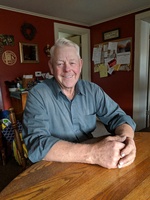 Everett Yerdon, November 7th, 2018
 Everett Yerdon is a second-generation farmer from Roseboom, NY. His family has owned the satellite farm since 1952. The Yerdons also owned a larger farm in Middlefield, which was sold off after Everett's father passed. Everett grew up in the Roseboom area, living on the satellite farm for most of his life. After raising his own family on the property, and hosting family events over the years, Everett is full of fond memories of his loved ones, farm, and community that he shared with joy and laughter.
Recounting growing up on the farm, he tells stories of childhood memories such as working on the barn at age seven. Expressing happiness with the active, outdoor lifestyle he experienced as a kid, he reflects on the fact that his children grew up on the same farm with the same ideals. Everett says that his family still enjoys coming home and he sees it as a sign of a good family dynamic.
Everett talks about his community of Roseboom and the changes he has witnessed over the years, expressing approval of the community and its respectful nature. He approves of the people in charge but shares his perspective of the struggles of a small upstate community, such as road maintenance and lack of town employees.
When asked about financial concerns, he discusses the struggles that many farmers are facing today. Changes to farming programs, insurance, agricultural markets, and machinery have led to farmers often being overworked and underpaid. At the same time, he appreciates some of the changes to farming over the years, such as better insurance policies and machinery to deal with harsh New York winters.
Everett recalls two extreme winters that prevented him from working, as snow blocked he and his family in for multiple days as they had to wait for the plows to dig them out. The challenging conditions would not stop him from taking care of his animals though. He and his son made it to the barn via snowmobile or snowshoes.
These conditions led to some accidents, as every farmer experiences from time to time, such as cars stuck in snow, milk trucks tipping over, or even a slip of the blade and a trip to the emergency room. But even with the hardships and the accidents, Everett Yerdon expresses his love of farming and the life he has led on the farm.
-
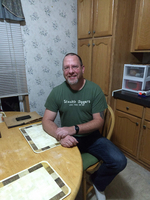 Daniel Diamond, November 19, 2018
 Mr. Diamond's family has been living in the upstate New York area for over 200 years. Mr. Diamond was born in Cooperstown, New York in 1970. He initially grew up on the Diamond farm in Cherry Valley built on the site of the Abraham Roseboom house. His recollections include the house he grew up in, which was originally a tenant house for hop farm workers. His father Charles Diamond worked as a dairy farmer when Daniel was young, then worked in logging.
Daniel Diamond grew up hunting. He began trapping muskrats at age eight, and has extensive experience in deer, turkey, and coon hunting (among other animals). In the interview Mr. Diamond recounts how hunting deer used to be done in the area, with drivers pushing the deer to standers. This is juxtaposed with today's practice of sitting in a tree stand or blind and waiting for a deer to walk by. It is Mr. Diamond's view that this new style of hunting has led to a more solitary approach which feels less communal.
The interview took place in Mr. Diamond's home, there was a wood stove running (which had a fan that is audible in the recording), and Daniel's son Nathaniel was also in the house.
Mr. Diamond speaks in a manner which often includes abbreviations and reflects local pronunciations. I have chosen to write the words in full to clearly convey their meaning written on the page with the exception of the word coon short for racoon. It is impossible to accurately reproduce all of the details of Mr. Diamonds speech in print and therefore researchers are encouraged to consult the audio recordings.
-
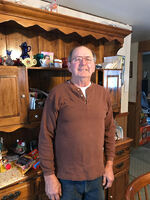 Jack VanBuren November 23, 2018
 Jack VanBuren lives at 131 John Deere Road in Cherry Valley, New York. The area in which the VanBuren family lives is also known as Roseboom. Located between Cooperstown, New York and Cherry Valley, New York, Roseboom was established in 1840. Once a bustling and active farming community, Roseboom has declined over the years. At one point it was home to a John Deere Dealership, a cheese factory, multiple operating dairy farms, an active Grange, and many other community shops and groups. Today, Roseboom has a population of around 711. Of that 711, the median age is 48, with the highest percentages of the population being between 50 and 64.
Mr. VanBuren grew up in East Worcester and moved to Roseboom in 1966 as a young man with his growing family. The VanBurens have lived on John Deere road ever since. After coming to Roseboom, Mr. VanBuren took an interest in the history of the town and the people who lived there, gathering knowledge from those he met. Out of this respect for and interest in history, as well as his own sense of need to preserve history, the VanBuren family started the annual event, Antique Power Days. Mr. VanBuren hosts Antique Power Days on his property each year on the third weekend in August and it is always free and open to the public.
I interviewed Mr. VanBuren in his home on John Deere Road the weekend after Thanksgiving. He prepared himself for the interview by conducting more research on the town of Roseboom to ensure that any dates or names he gave me were correct.
I have attempted in this transcript to preserve Mr. VanBuren's speech patterns and Central New York dialect, but for purposes of clarity in the transcript grammatical changes were made. It is impossible fully to reproduce aspects of speech in the written word so researchers and interested parties are strongly encouraged to also consult the audio recording of this interview.
-
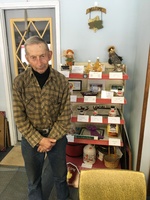 Warren Stannard, November 28, 2018
 Warren Stannard was born on July 22, 1937 in Cooperstown, New York. He is the owner of Stannard Maple Farm in Roseboom, New York, which has been in business for over 100 years. Along with selling maple syrup and other maple-based products he raises beef cattle there.
While also working on the farm, Warren worked 35 years for the Dairy Herd Improvement Association where his job was to help improve local dairy farms' milk production in the area.
In his 81 years, Mr. Stannard has seen a lot of changes in the local area, both in farming and the Roseboom community. He has seen many small dairy farms go out of business while the ones that remain grow larger and more efficient. As the farmers left, Roseboom changed from a community with multiple businesses to a town with few places of employment and an aging population.
He discusses his time growing up in Roseboom and on the farm that has been in his family for over a century. Reflecting, with a smile, on his time as a child on the farm he remembers stories of collecting maple syrup with neighbors and letting the pigs out, much to the annoyance of his father. He talks about his father serving as the local Justice of the Peace and speaks about his two sisters' roles on the farm growing up.
From carrying buckets of sap from tree to tree to having it all brought to his sap house with a push of a button, Mr. Stannard is in awe of the changes that the agricultural field has gone through in his lifetime, and he doesn't see those changes slowing down anytime soon.
Mr. Stannard doesn't know what the future holds for his local area and farming. He sees new people moving into the area and buying local farms. He doesn't see anything wrong with new folks moving as long as they are paying taxes. As for his own farm, he hopes that one of his neighbors will be able to use the land while his daughter, who works on the farm with him every day, will be able to continue with their maple sugaring business.
Mr. Stannard speaks in a distinct dialect and I have chosen to preserve some grammatical uniqueness. It is impossible, however, to accurately reproduce all the details of his dialect and therefore researchers are encouraged to consult the audio recordings.
-
 Nelson Mondaca, November 3, 2018
 Nelson Mondaca is a retired veteran of the United States Marine Corps where he trained as a helicopter pilot. He is a member of the LGBT community and lives with his husband, John Webb, in Cooperstown, New York.
Mr. Mondaca was born in Chile and immigrated with his family to Miami, Florida. He moved to Cooperstown after meeting his husband John Webb who is a Cooperstown native, in Miami Beach. He is an active member of the First Presbyterian Church of Cooperstown as well as a patron of the arts.
Mr. Mondaca's recollections span from his prestigious career in the USMC as a helicopter pilot to his hobby as an amateur photographer as well as his work as the owner of three therapy dogs who often visit patients at Bassett Hospital and provide emotional support. The most eye-opening narration Mr. Mondaca shared was regarding his voice as an active member of the LBGT community in Cooperstown as well as his work with his three dogs in order to make the lives of those around him better. He also discusses the welcoming atmosphere of Pioneer Street.
I conducted the interview at Mr. Mondaca's home in Cooperstown, New York. He was enjoying a relaxing weekend with his husband, John Webb, and their three golden retrievers. We moved to the basement level of the house so as to better cancel out any noise that might interrupt the interview. Mr. Mondaca had injured his shoulder during the time of the interview and informed me that he and John were going to attend a Chris Botti concert in Utica, New York later that evening.
Mr. Mondaca has a slight Chilean accent but his words are clear to decipher. He has an energetic tone of voice and I have done my best to preserve this distinct pattern of rapid speech as well as many of the terms, such as location names, he refers to in this interview. However, researchers are strongly encouraged to consult the audio recording of this interview if they desire word-for-word details and enunciations.
-
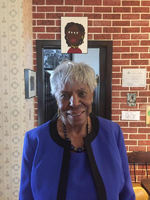 Robbie Dancy, November 11, 2018
 In 1943, at the age of two, Robbie Dancy moved from Alabama to Utica, New York with her grandmother, mother, and uncle. They were part of the mass movement of black individuals and families from the rural South to the urban North and West during the Great Migration, which began around 1916 and did not end until the 1970s. During that time, more than six million African Americans moved to northern and western cities such as New York, Chicago, Los Angeles, and Seattle. In these cities, demographics changed, black southern culture spread, and black-owned businesses opened. Dancy's family was a part of this trend. In Youngstown, Ohio, her grandparents opened Floyd's Barbeque, which brought southern homestyle cooking to the North. Dancy's parents followed by opening Liberty Street Cafe in Utica, New York. The cafe would later become Club George. Operating from 1946 to 2006, it was one of the oldest black-owned businesses in Utica.
During her college years, Dancy went to Bennett College in Greensboro, North Carolina. There she participated in the Civil Rights Movement, practicing non-violent resistance through picketing and helping to register black southerners to vote. She would go on to graduate from Bennett College with her B.S. degree in Biology, later becoming a medical technologist. Today, Dancy works per diem for the Bassett Healthcare Network in Herkimer, New York. She is also still active in the Utica community through her volunteer work.
The heart of this interview is Dancy's recollections of the differences between southern and northern life for African Americans during the Jim Crow era. As she says, she did not really understand racism until going to Greensboro, North Carolina from Utica, New York. Dancy brings us on a journey through her life of activism then and now. She also discusses her family and her hopes. At age 77, Dancy still has a fiery determinism and fighting spirit that show through in this interview.
-
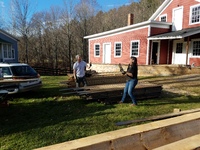 Dawn Raudibaugh, November 8, 2017
 Dawn Raudibaugh was born in Delaware County, New York and has spent most of her life living and working in the area. For nearly a decade, Dawn has been the Mill Manager at Hanford Mills Museum in East Meredith, New York.
Dawn spent her early life in the country, enjoying the natural beauty of the area and the rewards of hard work on her family’s dairy farm. Her relationship with her father’s craftsmanship and construction on the property helped guide Dawn to her future interests as a woodworker and Mill manager, but she has worked for a number of different local businesses and has pursued a variety of different activities. During that time, Dawn has raised a family and now has grandchildren and great grandchildren.
Dawn’s recollections include memories of her family farm and the natural world of her childhood, her various professional pursuits, the difficulties of balancing family life with work life, and her years as Mill Manager at Hanford Mills Museum. Some of the most interesting moments of the interview regard Dawn’s time at Hanford Mills. Having worked at the Mill in some capacity since the mid 1980s, Dawn has a unique perspective on the East Meredith community, mill operations, the history of the site, and the people she has worked with.
-
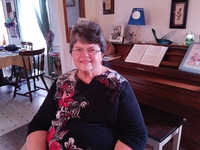 Olive Crews, November 15, 2017
 Olive Crews (maiden name: Olive Mathewson) is a resident of West Oneonta, New York. She grew up on a dairy farm in Westford, New York, before majoring in math at Hartwick College in Oneonta. She began teaching math to high schoolers in South Carolina before marrying a navy man and moving to Bahrain Island in 1970 for a year, and then again for a brief period in 1976. Even before gaining independence from Britain, the US Navy had a task force there, called the Middle East Force (now known as the Naval Support Activity), where Crews' husband was stationed. Living here at this time was a significant experience for Crews and is discussed throughout the interview.
Crews also lived in Georgia and Florida when some of her older children were young, though she spent a more significant period of time in South Carolina where she raised her six children. After divorcing her husband, she remained there for over 25 years until retiring to West Oneonta to be near family. Her considerable life experience has given her a unique perspective to examine the changes Oneonta has gone through, as well as notice and appreciate the similarities and differences between different cultures.
I interviewed Mrs. Crews at her home in West Oneonta. Her stories in this interview range from charming anecdotes about farm life to touching reflections on her reasons for retiring to Oneonta. She offers insight into the local farming community through stories of her own family farm and broader observations of what has changed over the years. She also reflects on the role community has played in her life–whether it be in Westford, Bahrain, or Oneonta. She also discusses the role religion played in her life. (She was raised in the Methodist faith, but converted to the Church of Jesus Christ of Latter-Day Saints in the early 1970s after making friends with a navy man stationed in Bahrain who was a member of the church.) Her observations and experiences of Bahraini culture are not only fond and enlightening, but also some of the most intriguing parts of the interview.
-
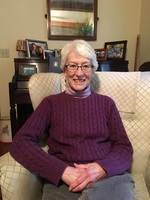 Anne Blabey, November 8, 2017
 Anne Blabey was born in Richmond, Virginia, but has lived and traveled all over the world, adding to her idea of personal identity along the way. She attended graduate school in Boston, and worked as a teacher for a time in Washington DC, where she met and married her husband, Richard Blabey. After starting a family, the Blabeys travelled around the world in Japan, Malaysia, Côte d'Ivoire, and Chile due to Richard's job in the Foreign Agricultural Service. In 2006, after their three children were grown and out of the house, Anne and Richard moved to Cooperstown, NY where they are active in the First Presbyterian Church. Mrs. Blabey volunteers her time in various missions related to the church and community including the local food pantry. She is also passionate about environmental issues.
Coming of age in the latter half of the 20th century, Blabey saw the rise of social and political movements that are still influential today. From gas shortages and environmental movement, to the feminist and social justice movements, the 1960s and 70s were a tumultuous time in American history. Some of these movements have shaped Blabey's experiences, whether through waiting in line for gas, or by refusing to work for less money than a male colleague. Her experiences living all over the United States and abroad have shaped her perspectives on home and identity. Blabey's accounts explore the themes of family, community, church, and the environment. Some of the most interesting parts of the interview deal with the challenges of finding home abroad.
I interviewed Mrs. Blabey in her home in Cooperstown, New York a week before the local Glimmerglass Film Days festival, the theme of which centered around the idea of home and the natural world. This, as well as our pre-interview conversations may have influenced the topics of discussion. Mrs. Blabey is a very expressive speaker with a very slight southern accent. I have done my best to preserve the tone of her interview, but researchers are encouraged to consult the audio recordings.
-
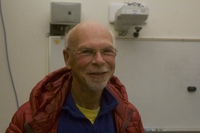 Peter Rutkoff, November 15, 2017
 Peter Rutkoff, a now seasoned professor at Kenyon College, grew up attending camps in Otsego County. As a child in the 1950s, raised in New York City, Rutkoff spent his early childhood at camp in Cooperstown, New York. Connected by Fieldston's Ethical Culture School, many of his friends were directed to sponsored camps where they were given the opportunity to explore the area. While given the freedom to choose his own summer experience, camp life in Cooperstown proved to be entrenched in traditions. Everything from baseball, to swimming, metal shop, wood working, and hiking make up a few of the many activities the Ethical Culture Schools' camps were offering its campers.
Rutkoff's time here in Cooperstown left a lifelong impression on him. His recollections detail the day-to-day camp activities made available to campers. His observations about camp life on Otsego Lake and a camp counselor's obligation to their campers reveal detailed intricacies of a time gone, but not forgotten. Most intriguing is the material in the interview concerning the role camp life and its culture play in his fictional book Cooperstown Chronicles. His memoirs elude to a place where almost anything can happen; good or bad. It touches on long-lost love, the spiritual elements of Otsego Lake, and the heart-pounding sensation that comes from almost losing a camper on a hiking trip.
I interviewed Prof. Rutkoff at the Biological Field Station in Cooperstown, New York. As a result of his teaching at the Cooperstown Graduate Program, his being here afforded me the opportunity to speak with him in a familiar place. His vested interest in the area make his account of life as a camper in 1950s Cooperstown an important contribution to the community stories project. Rutkoff speaks with a New York accent. This transcript seeks to reproduce many of the colloquialisms in his speech and tone. I have also chosen to preserve some grammatical particularities. It is difficult to accurately reproduce the distinct tone of my interview with Rutkoff. I encourage researchers to consult the audio recordings.
-
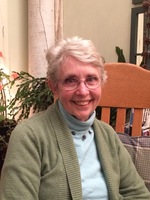 Jean Lyon, November 19, 2017
 Jean Lyon is the co-owner and operator of the Lyoncher Bed and Breakfast located in Cooperstown, New York. She and her husband, Tom, have welcomed guests from all over the world to their home for twenty-three seasons. In this interview, Ms. Lyon recounts how she came to the area from New Zealand and how she embarked on a career in the hospitality industry despite having a degree in fine arts and a teaching certificate.
In 1979, Ms. Lyon and her then husband purchased a motel on Otsego Lake about six miles from Cooperstown, New York. The family resided at the motel and enlisted the help of their three children to maintain the property and business. Shortly thereafter, Ms. Lyon and her then husband decided to divorce, leaving Ms. Lyon as the sole operator of the motel. Thankfully, friends in the area, as well as others in the local hospitality sector assisted and provided words of encouragement and advice. During the season, the motel was abuzz with guests, keeping Ms. Lyon and her three children very busy. But, that didn't stop Ms. Lyon from becoming more involved with the community. She volunteered at The Farmers' Museum and Fenimore Art Museum as an interpreter. Here, Ms. Lyon demonstrated open hearth cookery, folk dancing, and even quilting, a craft she still practices today.
Her involvement at these museums is what brought her and Tom together. Tom was a teacher and had brought a school group to The Farmers' Museum for a field trip. Her New Zealand accent gave Tom a reason to strike up a conversation and six months later the two wed at the museum.
Eventually, Tom and Ms. Lyon decided to put the motel on the market and they purchased the house where Lyoncher is now, expecting it to be their personal home. After the sale and renovations of the home were underway, the two realized that the addition of a couple of bathrooms would make the place an ideal bed and breakfast and thus, Lyoncher was established.
My interview with Jean Lyon, conducted at Lyoncher in Cooperstown, New York, revealed how people with various interests can get involved within the community and become successful business owners. Her recollections about her life in the United States, involvement in the community, and experiences in tourism highlight how diversity can exist in a small village in rural New York.
-
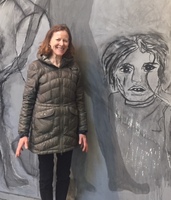 Christine Heller, November 26, 2017
 Christine Heller is an artist currently based in Cooperstown, New York. She came to this area in the 1970s with her husband, Marc Heller. While her art is her first allegiance, Christine Heller has also spent time teaching at various colleges and universities including Hartwick College and SUNY Oneonta. Many of her art pieces are installations, paintings, drawings, and murals and have been featured in art museums and schools across the United States. From 2005 through 2017, her subjects have included Syrian refugees, suffragists, children, dancers, and the cost of war. She combines powerful subjects through her art with activism and hopes to use art to educate others and break down barriers. Christine Heller is also involved in local community groups and activist groups, especially related to local politics.
In this oral history, Christine Heller describes several of her art pieces. She discusses her process and details impactful moments during the creation of various pieces. Heller explains in detail her work on New York State suffragists. She describes their history, her creation process, and the impact she hopes to have as she still feels the work of the suffragists is highly relevant today. Christine Heller also recollects some moments about art shedding light on moments between different ethnic groups and how art can bring people together, especially kids. Another topic discussed is Christine Heller's involvement in activist groups, her creation of an activist calendar for the local community, and some of their projects in 2017. Some of her artwork can be viewed on her website: https://www.christinehellerstudio.com/
I interviewed Christine Heller at her home in Cooperstown, New York. She had just finished a show featuring her portraits of suffragists and is preparing for another show featuring the suffragists, so they were a notable topic. The interview occurred the weekend after Thanksgiving, and so some family members were still visiting the house when the interview occurred. As a result, the recorder picked up some background noise despite us being far away, but Christine Heller's voice is never overshadowed by that noise.
I have slightly edited the transcription to modify some run-on sentences and remove false starts unless I felt they conveyed important sentiments. While quoting a Latino collaborator for one of her murals, Christine Heller quotes his use of a slur regarding African Americans when referring to the injustices Latinos faced in Denver, Colorado. The word is only used once and I have partially censored it, but as it was clearly a quote from someone else and I believe it emphasizes the discrimination that community faced, I have kept it in the transcript. It was impossible to reproduce fully Heller's sentiments and passion about her artwork, activism, and experiences, so researchers are encouraged to consult the audio recordings.
-
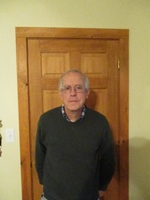 Richard Blabey, November 09, 2017
 Richard Blabey is a resident of Cooperstown, New York, where he and his wife Anne have lived for the past ten years. In recounting his schooling and formative years, he discusses attending a laboratory school while growing up in Albany, New York, studying at Hamilton College, being drafted into the military during the Vietnam War, and specializing in Asian history in graduate school. Blabey accomplished many things in his career before coming to Cooperstown. With the U.S. Department of Agriculture's Foreign Agriculture Service, he lived and worked in various locations abroad. He shares his perspectives on agriculture in New York, the United States, and beyond. In addition, discussing his life after retirement, he explains how he became involved in various Cooperstown organizations.
It is important to remember the context of the various times and places Blabey recounts. The era of the Vietnam War in the 1960s and 70s was a tumultuous time, and many people had strong opinions about the war, the draft, Communism, and international relations. He discusses the various cultures of the places in which he lived during his work for the Department of Agriculture. He also remarks on the social and cultural life of Cooperstown.
I interviewed Mr. Blabey at his home in Cooperstown, New York. I tried to reproduce much of the thoughtfulness, wit, and humor of Blabey's recollections. To do this, I chose to preserve some grammatical particularities. But, it is impossible to fully re-create all the details and tones of his speech, thus researchers are encouraged to consult the audio recordings.
-
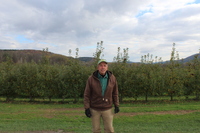 Wilfred Bruneau, November 9, 2017
 Wilfred (Willy) Bruneau, along with his wife Joan Bruneau, is the owner and operator of Middlefield Orchard. Growing up in New England, Willy has not always been in agriculture; he had a previous long career in the high tech industry, working for IBM and then Digital Equipment Corporation. Having found a love for growing his own fresh food as a side project during his career, when it came time for Willy to retire, he decided to start a farm. Thus, then in his sixties, he acquired what is now Middlefield Orchard and began developing what is now an expansive and growing fruit and vegetable farm.
Middlefield Orchard is an actively producing fruit and vegetable farm that sits on 130 acres of land. Most notable among the many different fruits and vegetables that are grown there, are the apple trees, of which there are thousands, with 28 varieties planted in rows. The farm plants new crops every year, and it includes peach, pear, and cherry trees in its orchard, along with berry crops and a plethora of different vegetables. It has all been a learning process for Mr. Bruneau, and he has taken to the profession in earnest, motivated by a desire to produce fresh food for the local community.
Middlefield Orchard is an established vendor at many of the local farmers' markets in Otsego County, the two largest being Oneonta and Cooperstown. At their farmer's stand, Willy enjoys interacting with the customers and other farmers in the community. He meets people who want to know where their food comes from, and how it's produced. But more than just the fresh food from the earth, he and his wife Joan also sell baked goods and jams, which are even more widely distributed through different retail outlets in the area. Willy himself can attest to why his wife's cooking has been so successful; you just can't get anything like it at the store.
In his interview, Willy goes over the more personal aspect of things, such as what led him to farming, and what he enjoys most about it, but he also details some of the more particular processes that he engages in during his day-to-day operational management of the farm. The listener can gain a real sense of the amount of thought, planning, and hard work that goes into organizing and maintaining an operational fruit and vegetable farm. They can also learn about the immense sense of value and worth that Mr. Bruneau gains for himself in completing the task of providing healthy and fresh produce to people within the Otsego County community.
-
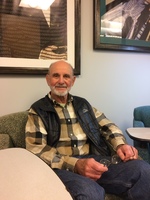 Jay Fleisher, November 3, 2017
 Dr. P. Jay Fleisher was born in 1937 in Liberty, New York. He is a Distinguished Teaching Professor, Emeritus at the State University of New York, College at Oneonta, where he taught Glacial Geology and Geomorphology. He has been involved with the JUNEAU Icefield Research Program (JIRP) since 1968 when he participated with 15 other post-docs, and again on multiple occasions as a volunteer faculty member. Fleisher served as JIRP's Interim Director from 2010 through 2011, then returned to Camp-10 as a teaching faculty member in 2013. He has several publications about glaciers.
This interview took place in November 2017, in the lounge area at IT Services at SUNY Oneonta. After the interview, Dr. Fleisher met with other students. He was very interested in what direction the interview would go in the meeting before this interview, so I gave him general subjects. This interview is about his career, and how he decided to study geology. Some of the most interesting moments of the interview regard Fleisher's memories of North Carolina and New Mexico on the subject of civil rights, and how he felt about it in that period. He decided to settle down in Oneonta because the town and the college provided a friendly and familiar environment. He is a very active person and has a lot of experience planning field trips to Alaska and Iceland. The interview provides information about his academic life at SUNY, his teaching experience, and his research. At the end of the interview he talked about how climate change can affect glaciers.
Some of the repeated phrases were edited out to make for more fluent reading of the transcript.
-
 Carol Malz, November 21, 2017
 Carol Malz is a lawyer in Oneonta and a past board president of the Otsego County Conservation Association (OCCA). Malz treasures our planet's natural resources. She grew up on Long Island, but through her travels, domestic and abroad, she was exposed to people in many different walks of life and she witnessed the needs they have. These experiences fostered a dedication to helping people less fortunate than she and advocating for their rights. Malz accomplished this goal by practicing law in multiple states. After moving to Oneonta, she continued to practice law and became heavily involved with the OCCA. Her expertise in the law aided that organization in a time when it was especially needed.
During her tenure with the OCCA, the Cooperstown Dreams Park baseball facility located in Otsego County, NY, sought to expand their operations. The OCCA argued that the facility's impact on nearby bodies of water would be significant. In an attempt to hold the facility's owners accountable, the OCCA, led by Malz, sued on behalf of their constituents. Although they were unsuccessful in the suit, the OCCA still attempted to combat what they perceived to be negative impacts on the surrounding area of the Dreams Park.
In a time of environmental disruption, champions and protectors of the environment play increasingly important roles in our society. The past thirty years have seen negative effects on many species and habitats, as well as extreme stresses on natural resources. As Malz alludes to in the interview, it is an overwhelming task to reverse and repair the damage humans have done to the Earth. Malz discusses not only environmental issues facing individuals locally, but issues of concern to the entire globe. She details her observations and legal contributions to protect people facing the effects of environmental concerns. Malz notes the individual power one person can demonstrate in turning their lives around and in saving the environment.
I interviewed Malz in her home in Davenport, NY. The sounds of her life permeate the recording, including her cat, the soft hum of traffic passing, and the faint indistinct voices from a nearby television. However, none of these sounds distract in any way from the integrity of the sound quality of the recording. She was careful to mention to me before we began that the OCCA would be the focus of the interview since it is the celebration of the 50th anniversary of the OCCA that brought this interview to fruition.
�
-
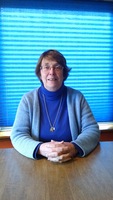 Judith Green, November 14, 2017
 Judith Green was born in Syracuse, New York, and attended Syracuse University for music education. Shortly after marrying, Green and her husband moved to Watertown, NY where she taught music in the local schools for three years before moving to Cooperstown. Green describes her adjustment to life working the Green family farm, and the process of raising dairy cows and later “beefers” while raising their family of three children. With frankness and levity, Green recounts the challenges and rewards of running a farm part-time alongside her husband, children, and a neighboring farmer named Henry. The restoration of the historic hop kiln on Green's property and the family's efforts to cultivate grapes for eventual wine production are particular highlights within the agricultural topics discussed here.
Green recounts her time giving private piano lessons and working in the Cooperstown public schools, where she taught music theory, recorder, and directed choirs. She discusses the value of music education as a path toward both developing personal discipline and expressing oneself. Green's involvement in the high school's musical theater productions as an accompanist segued nicely into her familial connections to music. Her mother and father were both musical and fostered Green's own talent through piano, cello, and organ lessons, as well as singing in the church choir. Green brought music into the lives of her own children, and encouraged their musical involvement and ambitions throughout their childhood and teen years. While discussing her family life, Green speaks of her late husband with potent emotion and affection, and addresses the realities of life after the loss of a partner.
Green also describes her experience attending and participating in the Women's March in Washington, D.C. and discusses her thoughts on the current political climate and the Trump presidency. She expresses political and policy concerns centering around environmental matters, corporate lobbying, economic assistance programs, medical insurance coverage, and a deficit of cross-party civility in government. She also addresses the transition from the caucus system to the petition system for nominating political candidates in the local region, and includes a breakdown of perceived merits and issues of both systems.
Green was and remains heavily involved in the Cooperstown area community. She has participated on the boards of the Hartwick library and the Cooperstown Foundation for Excellence, served as local Democratic Committeewoman, and directed the Methodist Church choir as a volunteer. She has also given a significant amount of her time to volunteer at the Cooperstown schools apart from her pedagogical duties. Though retired, Green is as active in the area as ever. She regards the supportive and close-knit nature of the Cooperstown community a unique aspect of her own life.
False starts, unfinished sentence fragments, and some vocalizations present in the recorded interview audio were not included in this transcript for the sake of clarity. I have made every attempt to preserve the intended meaning of all statements made by Green, and a majority of sentences from this interview remain intact and unabridged.
-
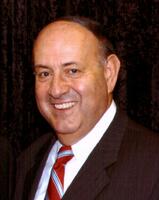 Anthony Casale, November 15, 2017
 Anthony J. Casale has had 40 years of experience in government, politics, business, and higher education in New York, Florida, and Washington D.C. During his time as a student at the University of Albany, he began his political career as an intern, working on political campaigns until he ran for New York State Assembly in 1978. During his tenure, he worked with several state agencies, including the New York State Liquor Authority and the Environmental Conservation Committee.
After 17 years serving in the New York State Assembly, Anthony Casale then worked for Congress in Washington D.C. He left the political sector when he was invited to work with the administration of Lynn University, a small school in Boca Raton, Florida before moving back to upstate New York to live in Cooperstown. Now, he is self-employed as a consultant for local politicians and businesses.
I interviewed Mr. Casale in his office in Cooperstown, New York. Casale's recollections range from explanations of his political career - both in New York State and in Washington D.C. to his time working in Florida and his current work as a consultant. Because of his lengthy career in government, a major point of discussion related to how the nature of politics and political campaigns has changed over his career, as well as the changing role of the media in politics. He provides his thoughts on the current political leadership and the public's participation in politics.
-
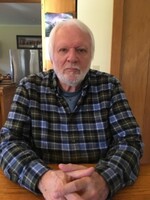 Mike Empey, November 8, 2017
 Mike Empey grew up around Otsego Lake, spending his summers swimming and fishing. He made a living working in local restaurants and as a licensed guide on the lake. In the mid- 1990s, Empey participated in the lengthy debate over whether to construct a public boat launch on Otsego Lake. This effort was unsuccessful, but the debate continues to this day as more and more people wish to have better public access to the 13th largest public body of water in New York State. Mike Empey is active in protecting the quality of the lake and protecting the rights of sportsmen who use Otsego Lake through his participation on different environmental boards.
-
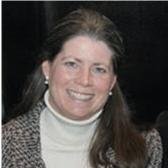 Ellen Pope, November 15, 2017
 Ellen Pope is the executive director of Otsego 2000 in Cooperstown, NY. As a child, Pope grew up traveling around the country and Europe due to her father being in the military. With this Pope gained to many different cultures that helped her in her career down the line by making her comfortable navigating life in different areas. In 2010, she relocated to Cooperstown in 2010 when she accepted the position of Executive Director of Otsego 2000 and has been in Cooperstown ever since.
During her time working abroad she would help facilitate environmental conservation discussions between different organizations and saw coming to Cooperstown as her chance to “walk the talk.” Pope has helped to facilitate many discussions about environmental threats within the immediate area--- one of the largest issues being has been hydrofracking, or unconventional shale gas drilling. Pope and Otsego 2000 argued that hydrofracking was threatening the area and surrounding communities.
Pope discusses when she first became interested in policy and the environment, along with her work overseas and her work here in Cooperstown. When Pope was talking she would often use her hands, either sliding them on the table, making gestures in the air, or hitting the table to emphasize points. The sliding of the hands and the slight hitting of the table can be heard in the recording. Just like with any narration it can be difficult to find good places to close a sentence, so there was some liberty taken with the placement of punctuation. It is impossible to reproduce the exact tone and nuances of an individual's voice; therefore, researchers are encouraged to consult the audio recordings.
-
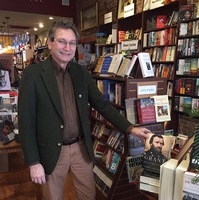 Jim Havener, November 6, 2017
 Jim Havener is a well-known and respected member of the Cooperstown, Milford, and Oneonta communities. Jim was born in Assumption, Illinois where he lived until attending college in Decatur, Illinois in the 1970s. Jim's mother was born and raised in Ireland, and Jim had the opportunity to experience Irish culture throughout his young life. With an interest in history and some experience working in museums, Jim decided to apply to the Cooperstown Graduate Program in the 1980s and was accepted as a student. After living in Boston for a time, Jim and his family decided to move back to the Cooperstown area and have lived in Milford, New York ever since.
Jim has worked as a museum professional, but also stepped outside of the field of museum work to establish his own furniture restoration business, The Furniture Doctor. Jim operated this local business in Milford, New York for thirty years, at which time he purchased The Green Toad Bookstore in Oneonta, New York. Jim is very involved in his community, and continues to provide his services as a museum professional on a part-time basis at the Milford Historical Society and The Farmers' Museum in Cooperstown. A small business owner, Jim understands the importance of community and his bookstore provides a place for the Oneonta community to gather together.
Jim reminisces about his childhood experiences in Ireland, his time at the Cooperstown Graduate Program, and his life as a community member and small business owner. Jim is particularly concerned with community as an intimate organism and expresses, toward the end of his interview, the importance of his role as a small business owner in the community of Oneonta - Jim is really trying to provide a setting that will foster a sense of community and togetherness.
Jim had a very distinct pattern of speech, and often ends his thoughts with phrases like “and that there,” “in those regards,” and “and that type of thing.” Jim is conversational in his speech, and so liberties have been taken regarding punctuation and word choice for readability. To fully experience the colloquialisms of Jim's speech, please refer to the audio recording.
-
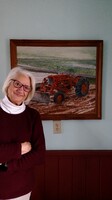 Kathryn Smith Mollach, November 14, 2017
 Kathryn Smith Mollach was born in 1936. She spent her early childhood in Delaware County, then moved with her family to Cooperstown, New York in 1945. The Smith family were cauliflower farmers. Kathryn discusses farming and the local farming community, as well as the particular challenges of growing cauliflower. Her parents, George W. Smith and Viola Freidenstine Smith, also owned dairy cows and had tenants who ran the dairy business. Kathryn's brother George Jr. took over the family farm in 1973 when George Sr. retired from farming due to illness.
Kathryn married Francis Leslie “Les” Mollach in 1958. They lived in Syracuse, NY and had three daughters. Following Les' death in 2009, Kathryn began in earnest her current business, Tanner Hill Herb Farm. She lives in the house she inherited from her mother, where she was raised. Kathryn seeks for the farm to be a place of rejuvenation and restoration. She sells herbs, garden accessories, ceramics, and other garden items from a custom-built shed adjacent to her house.
I interviewed Kathryn at her home on Tanner Hill Road, which has views from the front door of a picturesque pond, and rolling hills all around. Kathryn spoke of the community of farmers she knew growing up, and the differences she sees today. She also discussed her involvement with community groups including the Cooperstown United Methodist Church. When I arrived at Kathryn's house, she was having coffee with her friend Steve Purcell. Before we began the interview, Steve spoke about how the soil on Tanner Hill, called honeoye silt loam, is very well suited to growing herbs and vegetables. Kathryn references Steve, and this conversation, a few times throughout the interview.
Kathryn speaks jovially and with passion. She has a great laugh. I have retained many of her unique turns of phrase in the interview transcript, but it has been lightly edited for clarity and readability. Researchers are encouraged to consult the audio recordings of the interview, as it is impossible to reproduce all the nuances of Kathryn's speech.
-
 Alicia Pagano, November 12, 2017
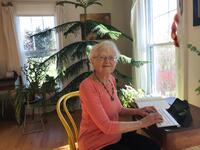
 Alicia Pagano, world traveler, poet, artist, and professor, shared her experiences growing up in Sidney and Unadilla, New York and her experiences traveling abroad and her family's life in this area. Born in Sidney in 1929, Alicia enjoyed growing up in a tightknit, safe community. During her high school years, she was active in band, cheerleading, and the senior yearbook. Alicia remembers camping, ice skating, and being free to explore her community. Alicia was a teenager during World War II; she remembers eating sherbet with hot chocolate instead of ice cream because of the rationing of eggs and cream. She remembers community events to raise money for War Bonds, and taking the bus and train due to the rationing of gasoline. She remembers when rural New York was first starting to have electricity and running water, and part of her family still used outdoor plumbing.
Alicia got her master's degree at Rollins College in Florida, and received her Ed.D from The American University. Between 1978-1983 Alicia worked as the National Director of Programs for the Girl Scouts and developed the Daisy program. During this time she traveled throughout the country to present the Girl Scout program. In 1984 she made her first trip to Africa where she met Jali Nyama Suso, a kora player and griot, and spent time in the backcountry of Gambia. During her second trip to Africa, Alicia attended the United Nations Women's Conference and traveled throughout Senegal, Kenya, and Gambia. In 1997 Alicia took a sabbatical to study early childhood in West Africa.
Alicia obtained a UNIFEM grant to start a school in the Gambia, but political unrest prevented the school from being built. Alicia helped numerous people become citizens and go to school in the United States, and she remains friends with them today.
Over the last 20 years, Alicia has traveled to Israel, Portugal, Mexico, Bolivia, Peru, Costa Rica, Thailand, and Nicaragua. Alicia has kept diaries of her travels, and is currently working on transcribing them.
I interviewed Alicia Pagano at her home in Sidney, New York. While visiting Alicia, I had the pleasure of seeing Alicia's poetry, her mother's crochet items made from recycled plastic bread wrappers, and her friends' artwork. Alicia is in the process of transcribing her mother's and grandmother's diaries. Her grandmother's diary, Nellie Converse Carr, can be found on the CGPcommunitystories.org website.
In the transcript I edited for grammatical purposes and inserted the names of individuals in the story to add additional context. I highly recommend researchers listen to the recording of this interview, as some of the names and places may prove challenging to pronounce. More importantly, the transcript alone lacks Alicia's excitement, humor, and personality.
-
 Hadasah Zutah, April 26, 1978
 Interview with Hadasah Zutah from April 26, 1978. Interview covers moving to the United States, her family, the importance of knowing one's background, and the Jewish community in Poughkeepsie, NY.
-
Belle Rosenthal, April 26, 1978
Interview with Belle Rosenthal from April 26, 1978. Covers her family's move from England to the United States, their religion, and education.