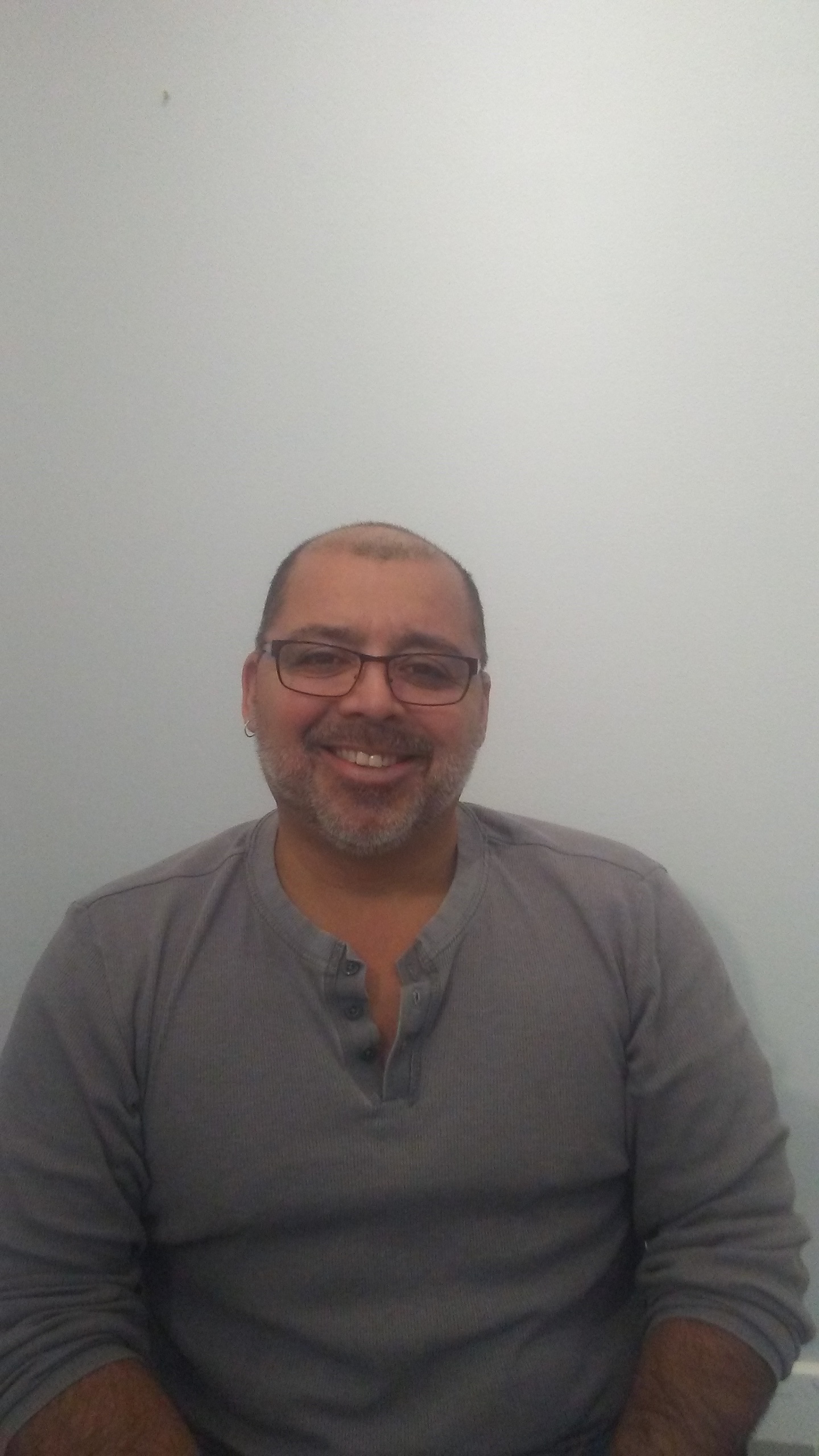
-
Title
-
Nelson Mondaca, November 3, 2018
-
interviewee
-
Nelson Mondaca
-
interviewer
-
Elena Pinter
-
Date
-
2018-11-03
-
Subject
-
LGBT activism
-
Don't Ask, Don't Tell
-
United States Marine Corps (USMC)
-
Helicopter Squadron
-
Therapy dogs
-
PTSD
-
Bassett Hospital
-
Miami, Florida
-
Cooperstown, New York
-
Roseboom, New York
-
Photography
-
African violets
-
Chile
-
Norman Rockwell
-
South America
-
Pioneer Street
-
Miami Beach
-
Halloween tradition
-
Operation Desert Storm
-
Glimmerglass Festival
-
Glimmerglass Condominiums
-
Cooking
-
Dutch Colonial
-
Carol Taylor
-
John Webb
-
First United Presbyterian Church of Cooperstown
-
Description
-
Nelson Mondaca is a retired veteran of the United States Marine Corps where he trained as a helicopter pilot. He is a member of the LGBT community and lives with his husband, John Webb, in Cooperstown, New York.
Mr. Mondaca was born in Chile and immigrated with his family to Miami, Florida. He moved to Cooperstown after meeting his husband John Webb who is a Cooperstown native, in Miami Beach. He is an active member of the First Presbyterian Church of Cooperstown as well as a patron of the arts.
Mr. Mondaca's recollections span from his prestigious career in the USMC as a helicopter pilot to his hobby as an amateur photographer as well as his work as the owner of three therapy dogs who often visit patients at Bassett Hospital and provide emotional support. The most eye-opening narration Mr. Mondaca shared was regarding his voice as an active member of the LBGT community in Cooperstown as well as his work with his three dogs in order to make the lives of those around him better. He also discusses the welcoming atmosphere of Pioneer Street.
I conducted the interview at Mr. Mondaca's home in Cooperstown, New York. He was enjoying a relaxing weekend with his husband, John Webb, and their three golden retrievers. We moved to the basement level of the house so as to better cancel out any noise that might interrupt the interview. Mr. Mondaca had injured his shoulder during the time of the interview and informed me that he and John were going to attend a Chris Botti concert in Utica, New York later that evening.
Mr. Mondaca has a slight Chilean accent but his words are clear to decipher. He has an energetic tone of voice and I have done my best to preserve this distinct pattern of rapid speech as well as many of the terms, such as location names, he refers to in this interview. However, researchers are strongly encouraged to consult the audio recording of this interview if they desire word-for-word details and enunciations.
-
Transcription
-
NM=Nelson Mondaca
EP= Elena Pinter
[START OF TRACK 1, 0:00]
EP:
This is November 3, 2018 interview of Nelson Mondaca by Elena Pinter for the Cooperstown Graduate Program's Research and Fieldwork course recorded at 97 Pioneer Street, Cooperstown, New York 13326. And thank you for being here.
NM:
You're very welcome…
EP:
Mr. Mondaca…
NM:
Welcome to our home.
EP:
Thank you. Where and when were you born?
NM:
I was born February 23, 1968. I was born in Chile, South America.
EP:
What was the reason you moved from Miami, Florida to Cooperstown? Why did you come from Florida to Cooperstown?
NM:
After I retired from the Marine Corps in 2010 after spending twenty years as an active duty marine, my husband and I were just looking for somewhere a little bit more quiet. He was originally from here and I was dealing with PTSD [post-traumatic stress disorder] and just certain aspects of the war. I was trying to get back to what I call the “civilized world,” back into society, and it was very hectic and tense down there. I found it too fast for me and Cooperstown seemed to be the right place to start a family and just to be with a community that was quiet. So that's one of the reasons why we moved up here. I mean, even though it has the Baseball Hall of Fame and stuff like that, we live far enough from the action and close enough when we want to see it.
EP:
You said you're originally born in Chile.
NM:
Chile.
EP:
Why did your parents decide to move to the States?
NM:
Just like every migrant that is looking for a better future, that was my parents and they moved up here in 1971, if I'm not mistaken. My dad started first, and then we came in 1978. Just looking for a better future, better work [coughing], running away from the dictatorship that was going on then, in Chile, at the time. Political problems and things so that's why they left.
EP:
In what ways culturally and/or socially is Cooperstown different from Miami, Florida?
NM:
[chuckling] Oh wow, in every which-way possible! Miami, Miami Beach where we lived, it is a vacation resort. People that go there go with one thing and one thing only [in mind], to have fun, drink, party, stay up all night, and enjoy the beaches and things like that. And even though we have a sort of a vacation area here in Cooperstown, people tend to come for the culture, museums, lake, and it is more family oriented. I would say Cooperstown is a little vacation spot with some sanity, while Miami Beach is a vacation spot with no sanity whatsoever [chuckles]. I guess that's why people tend to get away from it.
EP:
How do you personally interact with the community since you're not originally from Cooperstown?
NM:
We were welcomed right away. We were very surprised when we moved up here being a gay couple. My husband was born and raised here and from the stories that I hear from when he was growing up, it was a totally different community. Not just Cooperstown, but the surrounding area. He is originally from Roseboom, which is a small town about ten minutes away from here, so he wanted nothing to do with this part of the country after he left, but when we came up we saw that the area had changed, on how they view the gay community and everything else, and we were received with open arms. My husband is an educator. I'm former military and we just fit right in. I like sports, he likes books and things like that, and we have a little bit of everything here. We have sports, we have books, you know, there's a lot of educators, a lot of smart people here, and we just moved right in. We know a lot of people. We're very sociable people so we hang around and we see everybody that we can.
EP:
Can you please tell me how you and your husband met and where?
NM:
We met in Miami Beach. I was coming out of a relationship and he was single and we just happened to meet on a chat room, match.com. Two days later we met and we moved in together. So we've been together since April First, out of all days, April Fool's Day, April First of 2011.
EP:
Did he tell you about Cooperstown? Did he say it was…
[ TRACK 1, 5:46]
MN:
We had talked about it. The summer of 2011 we decided to take a road trip and we drove from Miami up the coast all the way to Nova Scotia, Canada, and then our last stop was Cooperstown and we rented a cabin on the lake for two weeks, and we invited friends of his, either from Cooperstown that lived here or from other areas and, we just kind of like, hung around there for two weeks and we fell in love with it. By the end of that summer, by the end of vacation, we were looking for a place to buy, so I fell in love with it right away because it just gave me comfort and that was something that I needed. I felt at ease here, especially with, you know, the world that I was coming from.
EP:
When you say comfort, what do you mean by that?
NM:
It's not a fast-paced town. People live their lives. People are family oriented. I like the fact that I could look out the window and there's kids playing in the streets. It's kind of something that I grew up with and then my teenage years and everything else, you start seeing that it fades away. The computer generation, you see that kids are in hiding all the time, but here it was safe. I didn't have to be looking behind my back all the time. I guess what I'm trying to say, it's just not fast moving. People are aware of what's going on. They're not just going from point A to point B and not seeing what's in between, so it was fun. I wanted to find something like that. I could just walk down the streets, say hello to somebody and I was going to get a reply back and not a head going down, looking at the floor and trying to ignore me. So that's what I look for in a town where I want to live.
EP:
Can you please describe for me the neighborhood on this street?
NM:
Oh my god, Pioneer Street! Pioneer Street is probably one of those streets that everyone wants to live in. Everybody knows everybody. Everybody loves everybody and respects each other. One of those streets that you don't really have to lock your doors, the garage door is always up. If you look at some of the homes, most of them don't have backyard fences and the kids are welcome to roam around from place to place. Our neighbors are wonderful. We share food together. We have a party every year. We close down the street and we all come out and we break bread together, and we talk about what has gone on in our lives the past year. Who has died, who has been born, who has moved into town, who has moved into the street and they get introduced, where the kids are going to college, who has graduated and who's gotten married. Everything that has happened with the families from year to year. So it's very interesting and even the people that have moved away for whatever reasons tend to come back and join the party and let us know what's going on in their lives. So who wouldn't want to live in a place like that? Some people would probably call it, that they don't want to be in the spotlight of everybody. I was one of those people. I didn't want people to know what was going on in my life and it's just nice when people care for you. If they don't see you for a few days, or whatever, they're going to knock on your door and say “Are you sick? Do you need anything?” I remember when we first moved in here, not even a day had passed and our neighbor across the street, Jim and Aileen [inaudible], came over and knocked on the door and brought us, you know, a plate of sweets, and introduced themselves. That's something that really doesn't happen anymore, so it was nice that we knew we were welcome in the community and that we were welcome in the street.
EP:
What made you join the U.S Marine Corps?
MN:
I joined the Marine Corps in [1992]. I was in college and the war was going on, Desert Storm, and I felt that I just wanted to give something back to a country that has given me something. So I wasn't obligated to do it but I felt compelled to do it. I was going to do it for four years then return to my books and after four years, I really enjoyed what I was doing. I was in a helicopter squadron. I was overseas. I was stationed in Japan for my first four years, and I just reenlisted and got into the groove of the military. I enjoy discipline and, you know, the uniform and things like that so it was a good fit for me. Twenty years later, I was still there.
EP:
How did you know that being in a helicopter squadron was your calling?
NM:
I don't think it was even the helicopter squadron. I think it was just the Marine Corps itself. It wasn't the particular job I was doing in the Marine Corps, even though it's a plus that you were going to be doing something, especially if you're going to be staying there a long time, that you enjoy, but I think it was just the whole aspect of being a Marine. I remember when I was in Chile, the navel academy in Chile, kind of like resembled the Marine Corps. They're very proper. Their uniforms are always pressed, you know, everybody looks up to them and things like that, and I was coming from a Catholic school background where I wore a uniform and I always liked to look presentable every single day. And I think it was like a transition in my life that it kind of like resembled where I was coming from, but then at the same time, you know, everybody knows the Marine Corps has a reputation. You say “Marine Corps” anywhere in the world and everybody knows what it is and it was a good fit for me. I liked to be part of the elite, so it didn't matter what job, probably, I was doing in the Marine Corps. It was just the fact that I was a Marine and just getting the title is hard enough. The rest of what you do is just extra, you know. Don't get me wrong, I enjoyed being in a helicopter because I enjoyed flying around, but that was just the extra bonus of joining and having the qualifications to do that particular job.
EP:
Now how does being gay affect your job in the Marine Corps, if any?
NM:
It didn't. It didn't affect my job at all. It affected my psyche a little bit because I wish it would have been more open. When I came in it was still “Don't ask, don't tell” and when I retired it was still “Don't ask, don't tell.” So even though I had a relationship with someone for twelve years while I was in the Marine Corps, he wasn't military and he wasn't part of the Department of Defense or anything like that. He was a civilian and he lived in another state. We tried to keep our relationship as far as possible from what I was doing just not to jeopardize my career in the Marine Corps. That was tough. It's tough to live a double life and a lie when one of the mottos of the Marine Corps is that you don't lie. But it was something that because I wanted to be a Marine, it was something that I had to do to continue to do my career. It didn't affect my job, as I say, because I was very disciplined at that. It just affected the day-to-day life. I wish I would have been able to go home to a family or not to keep secrets and not to have to be making up things all the time why I didn't have a girlfriend and why I wasn't married when most of the senior people like I was, towards the end of my career, they all had kids and were married and family lives and I didn't. That was a little bit hard; that was mentally challenging. And towards the end I really, I would say that I probably just had enough and really wanted to get out and retire already and just start my life because what I had at the moment was a life but it was a Marine Corps life, and I just wanted to have a full life just like everybody else.
EP:
Now when you came to Cooperstown, what was the first thing that you got involved in?
NM:
Well we got involved in the church. We were trying to, you know, we were doing a lot of work. We were going back and forth. We had two homes at the time when we first moved up here, so coming to Cooperstown was more of a summer thing for us. So, we weren't living here full-time the first year and a half or two. So, we didn't get involved in a lot of things because we were on vacation. We were trying to meet people and get to know the community and things like that, see as much as we could, and it wasn't until, probably when we moved her permanently, that we started getting involved in things, the gym. Whether it was trying to get involved in the church, in the arts, the opera, things like that, that both of us enjoy.
EP:
Speaking of the arts, I noticed there are several photographs of flowers…
NM:
Hmmm…
EP:
…What made you get into photographing?
NM:
It's something that I've always liked. I never took any classes or anything. I didn't go to school for it but people said that I have a good eye for it. I don't like to photograph people. I like rivers, waterfalls, mainly flowers. I think flowers are something, they're so geometrical. Each one of them is totally different from the other and they're just amazing to see. It's something that, I mean, that grows out of nothing and then it just becomes this beautiful thing. So, I get a kick out of going out there and seeing what nature has provided for us, everyday, and I get to do it with a camera, you know, and I've gotten good at it. I mean, to the point where hopefully, someday in the near future, I'll be able to put them up in a gallery and show them out. It's always nice to show what you see to other people to enjoy, and people seem to like them, to like some of the stuff that I do when I share it out there.
EP:
Is that a form of therapy for the PTSD do you think?
NM:
It is! There's a few things that I was able to do, to control my anxiety or PTSD. I was diagnosed with PTSD before I left the Marine Corps. I went through two wars in the Marine Corps. You sometimes tend to not see what's going on with you when you're still participating in those military activities until you actually move away from it. Then, you have to start seeing what's actually happening to you or what has happened. One of them was photography. The other one was cooking. And even though cooking had been part of my life since I was a child and I started cooking when I was in high school. I stopped cooking when I joined the Marine Corps and never touched it again for twenty years. Then when I retired and had met John, I started cooking again as a way of coping with PTSD and whenever I felt that I was getting a little anxious and overbearing, I saw myself in the kitchen and I would just get lost in the kitchen for hours and that relaxed me. And it gave a lot of food to my neighbors [laughing] but yes, it does help me when I see that things are going a little bit, I wouldn't say crazy, just when I see myself a little bit unbalanced, I'll take a ride and I'll take my camera with me and whatever pops in front of me, I'll start taking pictures of it and I get relaxed. Or, I'll stay in the kitchen and cook.
EP:
Is there a certain dish or food you like to cook?
NM:
Anything that looks beautiful on a plate. I always say that we eat with our eyes first and
the more color our plate has, I think, the more delicious it is. So, no, there's really none. I go through stages. We travel a lot so sometimes it depends on where we're coming from. If we're in Greece, for some reason I get a kick of Greek dishes, and I spend a month and a half cooking everything we had eaten when we were there. So it all depends. When we were down in Chile of February of this year, we came back and I was doing a lot of South American dishes. So no, there is not one particular dish that I do. I do tend to change my menu up here according to the seasons. I don't do a lot of grilling in the wintertime. Obviously, it's pretty cold that time of year. I do seasonal stuff but it doesn't have a theme. Whatever comes to my head, whoever is coming over to dinner to join us, we always have somebody for dinner, from the superintendent of school to our lawyer to friends of ours. We like company and there's a lot of people here who don't have children, or are here by themselves, and we tend to have people over for dinner all the time. So people always think that there's a party, but it's not really a party. I like to have people for dinner and just a gathering, I would call it, and so, no, there is no particular dish. I do have to keep track of who's coming sometimes because they've been here more than once so I don't want to give them the same thing over again [chuckles].
EP:
I noticed you have a collection of African violets. How long have you been tending to those?
NM:
Ahh…that's a funny story. It's probably been two years now. My husband was the one that purchased an African violet about four years ago because his mom used to have an African violet in the kitchen. My husband, the plant comes here with flowers but towards the end of the week, it has no more flowers left. And I was tired of money being wasted on plants and flowers, and then being thrown away. So I did a little bit of research on how to take care of them and I played with one of them and he grew and the flowers came back out. And out of that, seeing it flourish again, I bought a second one. I don't think it's gotten out of hand yet because there's only sixteen of them but it's nice to see them bloom. They're very delicate, you have to do certain things, not just put water in it and let it grow. The funny thing about gardening is that it was not something I thought I was good at, working with flowers, with plants. Whether inside or outside and because of the nature of the work I used to do, which was rough, hands-on, greasy, all that kind of stuff, helicopters, fixing machinery and then all of a sudden you have, like, this delicate flower that you have to be very careful with when tending to and I became very good at it and I love it. And it also relaxes me because you have to make sure you're taking care of something or else it's not going to grow. So that's how I got involved with the African violets because I just didn't want to see it die every time we got one and now it's grown into a passion that I take care of every week.
EP:
On the topic of design and art, can you please tell me a little bit about this house and the historicity of it?
NM:
Well, the house was built in 1906. It's a Dutch-Colonial style home. It's a very homey home. We are the third owners of the house. I don't know who the first owners were. We bought this house from Carol Taylor who is a long-time resident of Cooperstown and very well-known person. Her and her family lived here for 56 years, so we hear a lot of stories. One of the biggest things we heard when we bought the house from her was the tradition that she had and Pioneer Street has about Halloween. So we had to make sure that we had to continue those traditions. But the house, it's got a very classical look to it. When we purchased the house, we did a lot of cosmetic changes to it but we wanted to keep the character of the house itself. We did add a new bathroom on the second floor, but mostly we didn't touch a lot of stuff besides recuperating some of the old stuff that it has and bringing it back to life with just some brighter colors, but not losing the Colonial style of it. We spent probably about a year working on that. The last project that I did was this basement because I wanted a studio for myself and just kind of a place to get away from everybody even though everybody hangs out here anyway. So we did, we wanted to keep it the way it was with just brighter and newer things, and not lose the charm that the house really has. Some people tend to change moldings, change everything, and then you change the character of the home. You have a shell but you don't have a home like it used to be and we wanted to keep all those stuff and I found a way to do it with just restoring things.
EP:
So this was one of the homes historically in Cooperstown that needed to be preserved?
NM:
Well, all the homes in Cooperstown are historical because Cooperstown is a historical
area so you have to be very careful with what you do with the properties. Everything has to be approved by the village in order to do anything, which is a good thing. You can't just buy a home, tear it down, and just put a box in there. So yes, we wanted to keep the character of it. We had to get approvals of certain things and how it was going to look so the good thing was that if we tore something down to make it new again, it was the same way that it was originally. But it was brand new so we didn't change the shapes or the styles of things at all. Everything that was built from scratch, we made sure that it was built to look and resemble the same things that were originally there, from moldings to doors and things like that.
EP:
What made you come onto this street rather than any other in Cooperstown?
NM:
Two things: Because it's Pioneer Street and it has a very well-known reputation and two, my husband. We lived up on Glimmerglass Condominiums until 2015 but we drove down from over there every morning to go to the gym. Well, my husband doesn't like going to the gym. He didn't like going to the gym at that time, so he will make any excuse to make it the longest trip possible to get to the gym and instead of us coming down the lake and turning on Chestnut, which was the closest road towards the gym, he would maybe drive all the way down to Pioneer Street and then come up the street and do, like, the back roads to get to the gym. And we would pass by this house all the time and this house had been on the market for a few years and he always loved it. He said it would be nice to live on Pioneer Street. It's a nice neighborhood and it's got a lot of history and things. Everybody seems to talk about it all the time and here we are, you know, a few years later. We had a major incident in our lives in 2015, which kind of changed the course of where we were going. There was a fire up at the condominium and we lost everything. We lost the condominium; well, we didn't lose our lives and our dogs were still alive but we lost everything. So we had to start from scratch and we remembered that this house was on the market and we made an offer and we got it. So that's how we ended up here. One, that we wanted it and the other one, that we used to pass by it all the time.
EP:
Can you tell me about the Halloween tradition on Pioneer Street?
NM:
You know, I'm not really sure how it started. I've never really done a lot of research. I think Pioneer Street, being such a…
[START OF TRACK 2, 0:00]
NM
…Such a residential street with a lot of children all the time. Most of the people that live up here on upper Pioneer Street, which begins kind of like where the Presbyterian church is and ends at Beaver Street. We have Bassett Hospital right behind our house, on Fair Street, and if you knock on any door on upper Pioneer, you'll probably get a doctor to answer the door. And they all have children and I think it just became one of those things that everybody knew that there were family here with children and everybody had candies and it just evolved into something that I think we're going to request even to have the street closed down on Halloween because there's so many children. This past Halloween we had about 650 kids that came, so for us it's great. I mean, I go outside and I spend three hours handing out candy. The children are very polite. They come from all over, not just from Cooperstown. They come from other towns to get candy and they know they're going to be welcome here. So, like I said, I don't know how the tradition started but I think it's been going for a long time and when we got the house Karen Taylor was known to always have good goodies for the children. And so we were told that we had to, not that we had to, but it would be nice to continue the tradition and we have. Every year, we make sure that we're here for Halloween. We don't make any plans and we decorate and the three golden retrievers have a blast being outside with the children and taking pictures with them. We don't dress them up, but they love seeing all the kids and stealing their candy and things like that. So I have a blast. I think it's just the greatest thing. It's such a community event. The kids can't wait to do the parade on Main Street. They're always waiting for the parade to be finished because then the parade starts here on Pioneer Street. And the more neighbors we get now, the new neighbors that are coming, they have other mentalities, you know. We have another gay couple a few doors down and they put a pirate ship and they make it this huge event. It's always a different theme, and the kids get a kick out of it. There's lights and pyrotechnics going on and smoke machines and things like that, so it's pretty cool. You know, one generation leaves and then another one comes back and we're just making it better and better and better and everybody likes it.
EP:
Can you please tell me the names of your three dogs?
NM:
The oldest one is seven years old and she is Jersey. We named her that. My husband taught at Princeton University and so lived at Princeton and I used to live in Union City, New Jersey for a little bit when I was younger, so it sounded nice to have a dog named Jersey and it was a pretty name. So, Dakota is our second child. They have the same parents and we just figured since we had a Jersey we wanted to continue with a state for the second one. We had a friend, that her dog was named Georgia and the other one was Virginia, so we had to go west to find a name and Dakota sounded pretty and then the third one, who is a two-and-a-half-year-old, also from the same parents. We named her after their mom and her mom was Savannah, so she got the mom's name and we kept it geographical.
EP:
Are these therapy dogs?
NM:
They are. One of the things that we wanted to do was make sure that they had activities to do, not just be a dog that just sat at home all day long. Golden retrievers love interaction. They love people and they love helping people so we thought it would be a good idea. The first thing that we wanted to do was make them a therapy dog, but also be a reading dog that they could help children with anxiety of reading, help them with that. We haven't had much success here with that because it's just one school in the area and there are really a lot of dogs. But we found out having a hospital right behind us, they have a volunteer department that the therapy dogs could go and visit the patients and things like that. So we've been doing that for about six years now. We go on Thursdays and the three dogs visit the psychiatric ward and women go with the patients there and it's good therapy for them and the dogs get to do what they like doing and then we do our rounds in the hospital and visit patients and nurses and doctors and some of the people that are in the waiting areas waiting for their loved ones to come out and they have a blast, you know, so we do that a lot. We spend a lot of time doing that. We were doing a little bit of Focus or what used to be called Focus, the retirement centers, they seem to get a little bit anxious about that, so I'm now I'm keeping them just with Bassett and concentrating just there. I think they have plenty of work there. And we love it, you know, and they enjoy it and things like that.
EP:
Do you ever work with veterans also?
NM:
I don't. Working with veterans is a little bit different because the dogs that veterans use are specific for them. If I have to go somewhere where there is veterans, yes, they can go in but veterans tend to have their own dogs if they have an issue and those dogs have been trained specifically for the need of that person. So no, we don't. If I went to the VA [Veterans' Affairs] hospital I could take them and we visit some of the veterans there, but that's as far as I will go with that. Working with veterans is a little bit different. It's just very specific to each individual and the VA takes care of that with providing dogs that have been trained for years to accommodate that individual.
EP:
I notice you have Norman Rockwell images. Are you a fan of …?
NM:
We are. I'm a big fan of Norman Rockwell. He painted life as it was or as it should be. We were in his museum this past summer and if you look at some of the paintings that I selected to have on my walls, it represents a lot of what is going on in the country nowadays and it gave me comfort to actually see how our country has evolved from what it was and what he painted. That life was back in those days to what we wish it was now with the turmoil that [has] been going on in our country. So yeah, that's what caught my eye that, you have paintings from white older people with black children or black children coming into white neighborhoods and the racism turmoil that we have nowadays to the United Nations one that he painted, that immigrants make up this country. And then the Four Freedoms that one of our presidents spoke about, you know, freedom of speech, freedom to worship, freedom of the press, and freedom to gather. So some of the things that we're struggling with nowadays and some of the things that people want to take away from so, yes, I think more people need to go to his museum and get inspired and see how we were. Maybe they come up with something or they come out with something in their hearts. Yes, so I'm a big fan of him.
EP:
Who's your favorite artist or genre of art works?
NM:
I really don't have anything. It's just like music. I kind of like go with the flow. I don't have any style of music that I would say I like this one better than the other one. Growing up, I grew up in an era in the [19]80s where there was, you know, Depeche Mode and all those kind of things and then when I was in the military, a lot of the guys that are in the military, they like country music and I was into country music, so if it catches my ear or catches my eye then that's what's important to me. It's not any particular style or any particular artist or designer. I don't wear something because somebody made it. I wear something because I like it and it's comfortable and things like that. So when I'm at the gym, I like something that's going to get my heart pumping and I tend to listen to techno and it just keeps me going. When I'm cleaning out the house or when I'm working in the backyard some reasons, I tend to see myself hearing more of heavy metal that it just keeps me moving. When I'm cleaning or when I'm, you know, maybe doing something, I'm thinking it's more classical. So it all depends on what I'm doing and in the mood that I'm cooking and it's most of the time it will be, for some reason, I tend to be listening to Andrea Bocelli and when I'm in the car with John and we're doing long trips, all of a sudden, we tend to be listening to Spanish music. But no, nothing, more romantic Spanish music than anything. So it all depends on what we're doing, at least for me. There's no specific art or music or anything or artist or style that I would say defines me. Anything that catches my eye. It's like food. If it looks good, you know, I'll try.
EP:
So you mentioned music. I overheard you talking earlier that you're going to see a concert tonight.
NM:
Today we're going to go see Chris Botti and that's one of those things, you know, I could go from listening to a trumpeter. I guess he's very mellow. I love piano so the music that Chris plays it's just very similar. So we're going to go see him tonight. It's one of my husband's favorite artists, so we'll be there.
EP:
Have you seen anything at the Glimmerglass Festival that you particularly liked?
NM:
We are members of Glimmerglass Opera so we are season ticket holders. So we are there every summer to see all the performances and contributors to the Opera. So yeah, I mean, I don't like everything. Some of them, I wish I didn't go see. Some of them, I wish I could see like three or four times. Silent Night that they did this past summer, Joyeux Noel. I had seen the movie and I had seen the play before and I was glad that they did it. For those who don't know about it, it's during the war, World War I. The French, the Italians, and the Scottish fighting against each other and then they stop for Christmas Eve and they sang together and they continue fighting the next day. So it was very emotional for me, but it was beautiful. They did a beautiful job on it. Macbeth was really nice. I enjoyed that one. So there's been several ones out of the top of my head I can't remember all of them that they've done but I love going over there. We're friends with Francesca Zambello and her wife [Faith Gay]. We like supporting the arts and will continue to do it. It's always something nice to look forward to in the summertime. We're not baseball people. I love sports but that's not my forte to, like, hang out at the Baseball Hall of Fame. But we go up the hill, up the road and we have the Opera.
EP:
Which of the museums in the area do you particularly like?
NM:
I love The Farmers' Museum because of the animals and the baby goats, and we're also members of that, so whenever we have company would tend to either bring them or send them over there. I like The Farmers' Museum, the Candlelight Evening and Christmas. It's just one of those very family oriented things that you get to see your friends and their kids and everybody's having a good time. So I tend to be there more than Fenimore Art Museum. I will go see the new exhibitions that they have, but maybe I'll go there once or twice during the whole season, but The Farmers' Museum, I could go anytime I want. I enjoy it, so that's one of my favorite ones.
EP:
Would you say Christmas time is your favorite time around The Farmers' Museum?
NM:
You know, every season they have something going on and for every occasion, so no, it's not really any particular time. We try to enjoy every event that they have because it's always fun whether it's tractor weekend or you know, maple syrup, you know, all that kind of stuff. We would go and support it. Christmas is Christmas, you know, who doesn't like Christmas? And who doesn't like hanging around outside when it's snowing and you're drinking cider and everybody's having a good time and everybody has a smile on their face? I guess in a way it's the Christmas spirit and people singing carols and stuff, but I could enjoy The Farmers' Museum any time of the year. It doesn't matter; just little animals running around, that's good enough for me.
EP:
So what's your favorite Community event in Cooperstown?
NM:
I don't know. I really don't have a specific one. I try to enjoy everything that the community does. I wish they would have more events that involve the children on Main Street. I think we've gone away [from that]. When I talk to my husband, Winterfest [used to have] things for the kids to do. I think the town has moved away from it a little bit. And there's so many breweries and things like that, that it becomes a festival just for the older folks. Oktoberfest has just become something of music and the partying and things like that. I wish it would go back to what I hear it used to be. There was more focus on the kids and family and activities and food. I walked down there and there was just a few vendors and that was about it. So I wouldn't say any specific one. I wish there were more things related to food [chuckles] because that's what I like. But listen, as long as we continue doing things, that's the main thing. I mean there's towns that don't have anything going on. We tend to have a lot but we also have to realize that there are other things besides baseball. We can't just sit back and cater to everybody else that lives on the outside and not cater to the people that live here and that pay the taxes and that maintain the village for what it is. No, I think we owe it to ourselves to continue those traditions.
EP:
How in other ways have you seen Cooperstown change since you've moved here?
NM:
There really haven't been a lot of changes from when we moved here. I think we see more of a change in the culture of acceptance since we've been here. For a baseball town that you would say would be a more heterosexual-oriented town, there is a big population of gays up here, but it's a different mentality. The gay community, the LGBTQ community that's up here, it's either married, they have partners, they're family oriented. They have kids. They're part of the community. They're doctors. They're lawyers. They're teachers. They're superintendents. They're respected members of the community. Like a lot of single gay people would tell you, it's a very hard time to try to meet somebody if you're gay here because everybody is attached to someone. But you know, I think it's just the fact that Cooperstown has become so diverse. I guess it's because I live here now that I don't see the big difference. When I was traveling back and forth, I would see it more because I would come from a town where you see certain things going on that you don't like and then you come over here and everything's peaceful and everybody's accepting and all that kind of stuff. Now that I live here permanently, I just see that everybody just cares for everyone and that's a nice thing to have. There's no major wars going on here in Cooperstown. I think the changes that have happened, have happened for the best. We don't tend to go backwards too much.
EP:
Is there anything particularly interesting that you would like the community of Cooperstown or anyone in the Otsego area to know about you and your husband John?
NM:
I think everybody that knows us knows us pretty well because of the dogs. It's funny, we have friends in the surrounding towns and if we get introduced to somebody that doesn't know us, all they have to say is like “They're the guys with the three golden retrievers.” They're like, “Oh I've seen them walking around and they're pretty and you know, they're therapy dogs and blah blah blah…” so we tend to meet a lot of people because of our dogs. Everybody that knows us, everybody that gets to know us, they know that we're very friendly guys. We enjoy our community. We welcome everybody in our home at any time. I've always said that our doors are always open and everybody that knows us, that knows about us, knows that they're always welcome at our table. I'm always willing to feed anybody. I think that's something that I got from my grandmother. There was always enough food to feed whoever knocked on the door, and I kept that mentality that if John and I are sitting at the dinner table and somebody knocks on the door and they come in, I'm going to serve them a plate of food and they're to give me whatever they came for at the table whether they were asking for something. So, we are a welcoming group of guys here. What you see is what you get. That's just who we are.
EP:
Well, Mr. Mondaca, it has been a beautiful pleasure speaking with you and I thank you very much for your time.
NM:
You're very welcome. Thank you.
[END OF TRACK 2, 45:05]
-
Coverage
-
Upstate New York
-
Cooperstown, New York
-
1968-2018
-
Creator
-
Elena Pinter
-
Publisher
-
Cooperstown Graduate Program, State University of New York-College at Oneonta
-
Rights
-
Cooperstown Graduate Association, Cooperstown, NY
-
Format
-
audio/mpeg
27.4mB
-
audio/mpeg
20.8mB
-
image/jpeg
2560 x 1440 pixel
-
Language
-
en-US
-
Type
-
Sound
-
Image
-
Identifier
-
18-014
-
Abstract
-
Track 1, 05:46-Move to Cooperstown