-
Title
-
Gerard Snyder, November 12, 2015
-
interviewee
-
Gerard Snyder
-
interviewer
-
Samantha Strzepek
-
Date
-
2015-11-12
-
Subject
-
Van Hornesville
Law
Religion
Catholic
Same-Sex Marriage
Republican
Nonprofit
Equality
Pride
Education
Vegan
-
Description
-
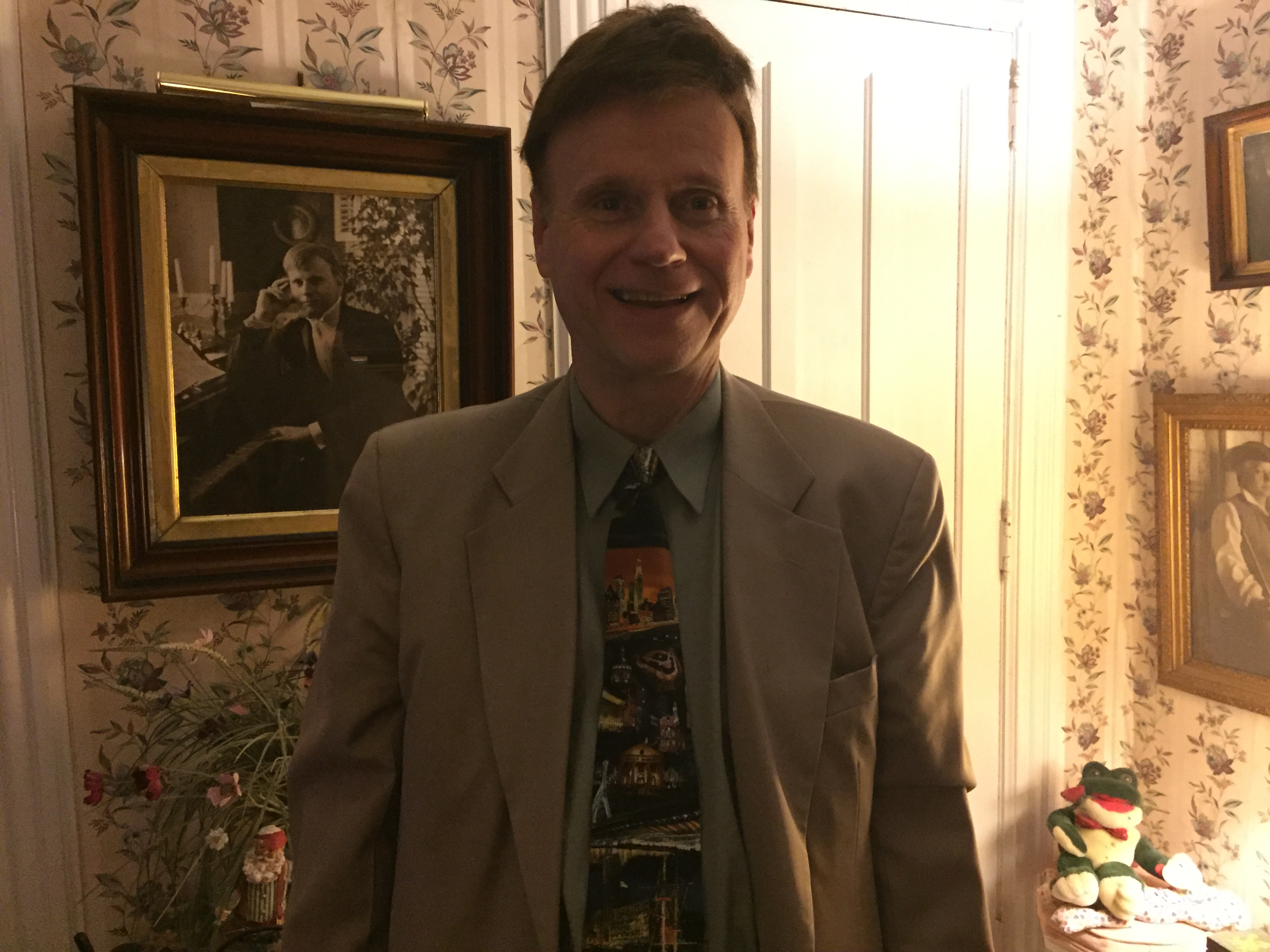
Gerard Snyder was born May 5, 1956 in Troy, New York. He is an established lawyer and holds his general practice, with specializations in real estate and estate planning, in Dolgeville, New York. Mr. Snyder is highly educated, having graduated from Pace University Law School in 1981. He is an important and influential member of his community, through his participation in various non-profit organizations, such as Little Falls Hospital where he serves as secretary on the board, and his local Episcopal church, St. Mary's.
Religion and spirituality play an important role in Mr. Snyder's life. He is a devout Christian, and believes strongly in acceptance for all within the church community. Mr. Snyder has dealt with many difficulties in his life, but has come full circle as a very successful and well-spoken individual.
I interviewed Mr. Snyder in his beautifully kept white, framed, Gothic-Victorian home in Van Hornesville, New York, where he lives with his spouse, Byron. His home is filled with pictures of his large family and other items that are important to his character.
Mr. Snyder speaks clearly and concisely. He is not difficult to understand, and talks very passionately about topics that are important to him. I encourage researchers to listen intently for changes within his tone throughout the interview that cannot be transcribed efficiently.
-
Transcription
-
Cooperstown Graduate Program
Oral History Project Fall 2015
GS = Gerard Snyder
SS = Samantha Strzepek
[START OF TRACK 1, 0:00]
SS:
This is the interview of Gerard Snyder, by Samantha Strzepek, on November 12, 2015 in VanHornesville, New York. To start, can you tell me a little about your upbringing?
GS:
Okay. I was born May 5, 1956 in Troy, New York, and I was one of five, actually one of six. My oldest sister passed at age six months, so she is not up in the pictures that I just mentioned off the record. But, she died with spina bifida. If you've heard of that. She had an open spine, and pneumonia set in, this is 1933 when she passed away. But there were five living siblings, including myself, and they are actually pictured up there on the mantel. My oldest brother John, who is 81, and my sister who is roughly 79 now, I guess, Janine, and then my brother Donald, who is an attorney in West Winfield, he is 76 or 77, something like that. My next youngest brother is William, or Bill, he is eleven years older than I, so he is 71. And then myself, so I am 59, getting close to 60 however. But, I was born in Troy, as I mentioned, raised in Troy, in the Capital district, and lived in that area for grade school, high school, and college; all Catholic schools. I was attending St. Paul the Apostle grade school. Before that, kindergarten was at School 17, public school, and then I attended four years at LaSalle Institute, which was a military school. You'll notice we're all dressed in military garb up there. My mother was sort of instrumental [in this]. She wanted us all to attend this school, all the boys that is. My sister went to Catholic high; Catholic Central High. After that I went to Siena College in Loudonville, a suburb of Albany. I told you I majored in English Literature. I started out in political science, but didn't care for that too much. They only had a couple of professors, and I got tired of those professors, so I switched majors to English, and that is what my undergraduate degree is in. Then I attended Pace University Law School in White Plains, and graduated in May of 1981 there. Just to backtrack, Siena was May of 1978, and high school of course May of 1974. I just celebrated a big one there. And, grade school was 1970. I was raised in suburbia, basically, a part of Troy that is not in the inner city, but in the suburbs. It was a nice part of Troy, Park Boulevard, and I didn't follow the lead of my siblings. I could've probably, and would have been expected to follow in their footsteps and play golf on a professional level. My oldest brother was a golf professional at a country club in Virginia for all of his adult life. He actually was country club pro, at what used to be a slave plantation of Thomas Jefferson. They have like 2,200 members; many of them were from D.C. [Washington D.C.] They were non-resident members. And then my sister Janine, she's not a pro, but she could have been. My brother Bill could've been very successful. Everybody in Troy was glad to see them move out of the area because they were winning right and left. But, I think I felt more intimidated by that. Because of their excellence, I thought that I was expected to be as good or better, and I just kind of shied away from it. My personal life may have also caused me to shy away from a lot of things in social settings, certainly. So, that was part of it. My brother that is a lawyer, I kind of followed him. He was here in West Winfield, and was sort of a role model for me. I didn't really want to go into sports, and didn't think I had the ability quite frankly. So I kind of followed his lead and chose the law as a profession. I liked the small town practice, and he was fortunate enough to practice with attorney, Tony Constantino, in West Winfield. His friend, Charlie Sullivan, was my former law partner. Mr. Sullivan started the law practice in Dolgeville, where I practice, in 1936. So, Mr. Sullivan's son actually is a lawyer and practiced in the firm for a few years; not very long. Primarily during the time his mother became ill and passed. As true with many families that grow up, and I see it living and working in Dolgeville, sometimes kids don't want to live in the same community that they grew up in. They want something bigger and better. So, Charlie Sullivan's son moved on to Albuquerque, New Mexico, leaving an opening for myself. So, I actually interviewed initially in October of 1981 in the firm. Charlie Sullivan really wasn't anticipating filling the vacancy, but he did! [Laughter] So I've been there since then, October of 1981. I did have to leave because I didn't pass my Bar exam the first time. I passed it the second time, so I had to leave and go back to school, re-study, and then took the exam once again and then passed it in February of 1982. I then was admitted to practice in June of 1982.
[TRACK 1, 6:44]
SS:
Can you tell me more about what your law firm does, or what type of law [you practice]?
GS:
Yeah, sure. It's been traditionally a general practice law firm, but in a time, and more so today, of specialization, we do tend to do a lot of estate planning and real estate work. There are other things that we do as well, but those are the primary areas of work that we concentrate in. I don't know if you care to hear some of the others, but when I first started out, obviously I wasn't going to be doing what my boss did, and that was basically estate work and real estate. So, I had to start out doing criminal defense work. I did assigned council law guardian work, if you're familiar with that. But, it's basically assigned work through the county, public defender program, assigned council program, where you will represent indigent folks who are unable to afford to pay privately, so then they are appointed an attorney, and then the attorney is reimbursed by the county for the work they do for that client, or the work I do for the client. I did family court. I would do anything that might be related to custody, child custody, child support, and child visitation. Unfortunately family offenses, some of the not-so-pretty areas of that court, that I would be appointed to represent some folks in some cases. It was young kids that were incorrigible in school; they just didn't follow rules in school, and probably at the house as well. So the parents file what's called a PINS petition, persons in need of supervision, that then resulted in a family court placement case being filed. It might be a juvenile delinquency or it might be just a PINS petition. Then you might get school involved, you get the parents involved, but as a law guardian you have to represent the child, and you have to try to be independent of those other parties that are trying to influence your decision. What I found out very quickly is that the law guardian, and their position in the matter, was taken quite seriously by the judge because we're supposedly impartial and independent, and we're supposed to represent the client and present the position of the client. Even aware that sometimes that position wasn't always the best. What do kids know? But, I got into arguments with parents and it was difficult. I lost my cool a few times. I try not to do that. But those kinds of cases can really cause you to do that, and I think they're emotionally as a result. But, that's how I started out. So I did a lot of that, and then I kind of eased into some of the other areas of practice that I mentioned. We do some matrimonials and divorces, usually uncontested, so we're not getting involved in a lot of the nasty stuff. We don't do, Samantha, a lot of litigation. So, we're more or less, the English system defines law sometimes as being a barrister or solicitor, and we're more solicitors if you will, in the English legal system. We do office work. We can appear in court and handle matters that go in that direction. But, if you're not doing it all the time, it is sort of an expertise or specialty that one that can get rusty, and be not as sharp on rules of evidence, things of that kind, that are important in that arena. So, we often bring trial council into the picture when we have trial court matters, and we do have those kinds of matters that involve, in some cases, trial council getting involved and assisting us in that type of work. So, I don't know if that gives you enough information, but that is what we kind of do.
SS:
To backtrack a little, when we were discussing your family and their roles in golf, you said before your personal life would have had an effect. Would you mind describing how so?
[TRACK 1, 11:24]
GS:
Well, as I told you I'm really not off limits in anything. I think my sexual orientation comes into play in that regard, and I have to be truthful in indicating that while I've been successful in the public arena, in terms of school and what I've done in my workplace, sometimes my private life was secondary and took a backseat because of pressures, societal, family, that obviously I had to deal with and contend with. So those kinds of pressures caused me to be somewhat introverted in a social setting, and for that reason perhaps the arena of professional sports would have been maybe more of a being on stage, if you will. I just didn't feel comfortable outside of my own little world, if you will. In that sense, I was somewhat limiting myself in terms of my full potential, who knows? But, I've always considered myself to be a late bloomer. Maybe one of the reasons I think I did stay in school as long as I did was because I was postponing decisions about marriage, and pressures to perhaps be conforming in that sense. I knew that wasn't right for me, and I just didn't feel comfortable making decisions based on societal, family, pressures that I knew weren't right for me. In that sense, I was limiting myself, I think, because it was hard for me being raised Roman Catholic, and you are as well, and you know the situation with the church. I'm very happy with Pope Francis right now, and some of the teachings that he has tried to encourage to provide more acceptance and welcoming. I've always considered myself a very spiritual person also, so religion is very important to me. I just felt this dichotomy, where I just loved worshipping in the church setting, but I just felt I wasn't fully welcomed or accepted into that setting. So, it was very difficult. I struggled with my own sexual identity and I literally just postponed coming out, as many do, until I felt comfortable. I certainly was outed, and attempted to be outed in high school. You know how bullying can be. I'm sure I was somewhat subjected to that, and it caused me even more so to become introverted, so I had to deal with that. Finally in college, if you want to know more, that's when I came out actually, and I was actually outed, if you will, by someone when I was an intern for an assemblyman in the Capital. I actually worked for an assemblyman, Fred Field, and there was a gentleman that worked in bill drafting, who lived in Troy, and he didn't drive. He knew I had wheels, so he asked me if I would mind driving him home. That's how I was outed, if you will, because he was gay, and he could pick up with me that I was too. He also worked part time at a bar, a gay bar, in Latham. He invited me to go to the bar with him one time. Quite frankly, this was 1976, and I actually, for the first time recognized that I was not alone! I just felt like, gee, this happened to me, I wonder what other people are like. If there are other people like me. That was my first exposure to anybody as gay or lesbian. So, that was an awakening for me. It opened up a whole new world that caused a lot of controversy as a result with my family when I started to live my life, of you will. That was very difficult. So, I sort of did it behind the scenes, because I knew it wasn't going to be accepted. So, I kind of did things privately. Again, withdrawing from many societal functions, in reaction to some of the pressures that I had experienced in that regard. I mentioned to you that I probably stayed in school longer. Who knows if I would have been a lawyer if I were straight, and were living my life the way most people lived. I might not have chosen to stay in school, and might have done something different. But, that was my way to postpone the inevitable decision of marriage I was being pressured into. You know, I did date women, if you will. [Laughter] I went to proms, and you had to just play the game basically. I know a lot of people that did that. Some people have chosen to get married, in the heterosexual sense, that weren't straight. I see that even in my practice. I see some people who have later in life chosen to end the relationships like that. I just didn't want to fall into that trap. I had friends who were married and had children actually, and divorced, and later lived their lives as they were, in my mind, born to live. I just didn't want that to happen to me. So, I kept my postponing the decision in that sense, so I chose to stay in school. It seemed like as long as I was in school, I don't need to get married, don't need to make decisions like that. I guess that was my escape. I did all right. I was class salutatorian in high school. I was a cum laude graduate. I did have one bad semester at Siena College, where I was forced to be away from home. My mom was very gravely ill in Boston. She had to have some serious surgery, and I actually went over there and lived in Boston while she was going through that surgery during my second semester of my second year studying at Siena. So, I had a very bad cumulative that semester, which dragged me down. But, I've always tried to do well. I guess I have some ability, but I'm not naturally bright. I have to work at it. I don't know about you, but nothing comes easy to me. I have to work at it, but I've done all right. I think socially I've really come full circle. I've really decided that I've found myself at long last. I have someone that I've actually married, and we have a very nice life.
[TRACK 1, 18:36]
SS:
Can you tell me more about your partner?
GS:
Yeah! His name is Byron Roth, and he's upstairs right now minding the cat. [Laughter] He and I got together in 1996. I actually attended a Phantom of the Opera performance, down in New York City, with my dad. We were staying at one of my former landlady's homes. I actually, reading the newspaper, the Westchester [Item], saw Byron's ad. I followed up on it obviously, and you know, things worked out. He moved up here in 1997. He worked for the Scarsdale Library, and he actually [he applied] he worked at NYSHA [New York State Historical Association Library] library. Loved it! Absolutely loved it. He loves genealogical work, and that's his real expertise, even though he has a master's degree in education. He's an elementary education professor, or teacher rather, and did do some of that at Cooperstown part time. He was a sub. Fort Plain, Owen D. Young, Dolgeville, Cherry Valley; he made the circuit. He just didn't like it. Maybe it is because of his sexual orientation, I don't know. You know how kids can be sometimes. But anyway, he really was sorry he didn't go into library science, and they didn't offer library science at Iona College, where he went, until after he left. So, he never got the degree, but left education. He did do some teaching downstate as well. He's from Mount Vernon, New York. He did some teaching down there, but then another opportunity arose at the Scarsdale Library, where he worked there for 14 years. He was working there when I met him. He was warned by his colleagues about me, [Laughter] even though I was an attorney, that I might be some hick from upstate, or redneck, of course I don't know how that would fit. He was expecting through their description that I was going to have a big beard. Anyway. It didn't work out quite that way, fortunately for his benefit and mine, and he decided to relocate up here. He misses his home tremendously. He's here only because of me. But he is, I think, reasonably happy. We have a good life. He works in my office. That's been since he was let go at NYSHA. He didn't like education, and not too many jobs out here, so he started working in our office. Right now he's a telephone receptionist person, and he actually does a lot of genealogical work for us. I mentioned we do a lot of estate planning, so he does a lot of searching for heirs for us on Ancestory.com and other Internet sites. So it helps me out a great deal. He did do some of that part time down in Westchester. He worked for some attorneys in New York City and Westchester doing the same type of work, which sometimes you just can't find these people that you need to find. If you don't know where to look, you're kind of stumped. So, it avoids what we have to do ultimately if we can't find people, [which] is publish citations in the newspaper, and that's expensive and time consuming. You're really not accomplishing, in most cases, a lot because you're not locating the people. So, through Byron's help we've sometimes located some folks that we were hard-pressed to find. Even clients, who you would think should know, didn't know the families, and for that reason we appreciate Byron's work. So, he does that, answers the phone, does all kinds of running for us, and spares the secretaries time for the grunt work of getting the work out. Not having the phones, as you can imagine, interrupting that, and to no have to deal with that on a constant basis is helpful.
SS:
Going off that, how do you feel about the legalization of same-sex marriage in the United States recently?
GS:
Obviously that, to me, was a breath of fresh air. I mean, to me I have to backtrack a little bit. When I did initially come out, and went to the bars, I was not a bar person. I never was. Unfortunately back then, the only place you could meet somebody it seemed, was going to a bar. But, those kinds of individuals, and I don't mean to put people down, but you didn't always find the same type of professionals. You found people who had addictions. You found people who were feminine, and I don't want to put anybody down, but that wasn't me, and I just had trouble identifying with that group. To me, there was a lot of promiscuity, and I, also because of my religious upbringing, didn't believe in promiscuity. I really wanted to be with somebody, in that sense, that I was in love with, and that was not the mindset of the bar crowd. It was basically who can I go home with tonight? Thankfully, I'm alive today probably because I wasn't that type of person. A lot of people that I knew from back then are no longer with us. In fact, the very first person I dated is deceased. Died of AIDS. He was a pharmacy student at Albany Pharmacy, a professional that I was head-over-heels in love with. I just wasn't ready emotionally, plus I was getting ready to perhaps go to law school, he was in pharmacy school. I don't know what his plans were going to be. He did obviously finish as a pharmacy student and got a job in that profession. He actually moved to San Francisco, I heard, and unfortunately contracted AIDS and passed at age 36 or something like that. So, I pray for him every night. I still feel an emotional attachment to him. I think we all remember our first person. But, again, back to the subject of marriage. To me, it's important to have a relationship, sexually or otherwise, with a person that you really want to spend your life with in some ways. I realize we have to figure out who that person is. To me, to open up the door to marriage, just opened up the door to less promiscuity, and opportunities for more monogamous relationships. Perhaps a sense that this is a life that may be just like everyone else's life; that you can settle down, and have a permanent type of relationship. Heterosexual and homosexual marriages can fail obviously, we all know 50% of heterosexual marriages end in divorce, and I'm sure we haven't seen yet, it's going to be soon determined. But, I was talking to a lawyer in Kingston that told me his primary practice right now, I don't know what he did before, is preparing pre-nuptials for same-sex couples, wanting pre-nuptial agreements. All this is a new world opening up, but I just feel like we're part of the rest of the human race now. Byron and I file a joint income-tax return. There are many benefits certainly that I'm now seeing financially with that joint filing, and other legal rights we really weren't entitled to, so much as to visit your partner in the hospital. At one point, you weren't allowed to do that. [Mary Imogene Bassett [Hospital] is the exception. They've always been very positive with same-sex couples, and I feel very comfortable at Bassett. They have, even at the professional level, same-sex folks that are associated with the hospital, so it's very progressive in that sense. So, I'm very much thrilled with the idea of same-sex marriage. I, for years, lobbied for that in a low-key way. I'm not the person out there on a bandwagon, but I would write letters and I would make phone calls, and participate in that sense. I belong to the Human Rights Campaign fund, and support organizations that try to spread legal rights for people that haven't had them.
SS:
Can you tell me more about any non-profits or organizations that you've worked with?
GS:
Yeah. I mentioned that I do, and the primary ones that I'm associated with right now are the Little Falls Hospital, now a subsidiary or affiliate of Bassett, and I am on their board. I've been on their board since 1994, and currently the secretary of the board. I've enjoyed that relationship very much. That's the year my mother passed away, in 1994, and I was spending a lot of time in hospitals back then. My father's brother was a member of a hospital, I think he was on the board of St. Mary's, where I was born actually. So, I liked him. He was an editor of a local newspaper in Troy, and I kind of liked him in that sense. He was sort of a role model. I thought, gee, maybe that's not a bad idea to become [a part of]. I was asked to be a member of the board, and I think, no offense, I was probably showing that I was somewhat successful. I had an office in Cooperstown for a while. I actually dated somebody from Cooperstown. Through that relationship, didn't last very long, but through that relationship I had a law office over Danny's Market. I don't know if Danny's Market is still there, but I was up in the iron-clad building on the second floor for a couple of years. I eased out of that. I had a connection with that family, but when the relationship ended, that connection sort of went too. I did finish out my lease term, and enjoyed my work, and still have friends from that area that I'm close with. Cooperstown is a great place. I don't know what you think, but I like Cooperstown.
[TRACK 2, 0:00]
GS:
We were just in Saratoga Springs for an income tax school, and that's a nice community also. A little bit more urban, I think, than Cooperstown. Now, Byron prefers Saratoga. He's more of a shopping type person, where Cooperstown is more baseball, as we all know. I'm more of a baseball person, so in that sense I have an attraction to Cooperstown. Plus, it's a little bit smaller of a community. I kind of like the smaller town. I didn't know if I'd ever like Dolgeville, growing up in Troy, but I fit in. In fact, one of the comments I heard from my brother and sister was, “Why do you want to work in an area where there is nothing but farmers?” So, I learned very quickly from them, and from personal experience, that some of the farming community folks are [very] highly educated, well respected members of the community, who have a lot to say and offer. I've changed my opinion certainly about farming, and what those folks do for a living. Its not easy work, and it doesn't mean that they aren't on the ball intellectually, because they are. I've certainly seen that.
SS:
How do you feel about the current presidential election, or the candidates' political platforms?
GS:
Well, I am a RINO. I'm a Republican in name only. [Laughter] This community is basically [primarily] inhabited by Republicans. My brother and I came from Troy. My father was a registered independent because he was a sign painter. He started out as a cartoonist, but then he became a sign painter. He just felt that he would play the field, and he would basically not register in either party. So, he would get business from both parties. That was smart. My brother Donald, when he went to West Winfield from Troy, he was a registered Democrat. He ran for the school board as a Democrat, and got beat badly. So, he then referred to his party affiliation and became a registered Republican, and he won. Unfortunately, you'd hate to think that, but a party can make a decision for most people. They don't necessarily look at the person, or the qualifications of the person, they look at the party affiliation. So, for that reason I'm a Republican, but I do vote my conscience, and I do look at the candidate. I have to tell you, because of the record of Democrats vs. Republicans on my issues, of important social issues, I have a greater allegiance to the Democratic party right now because of that. Even though there were a lot of good principles I believe in that the Republicans stand for, I really don't want to say I'm a single-issue voter, but until same-sex marriage anyway, I was certainly that. I'm starting to ease away from that maybe a little bit, and can look at other issues. I was primarily Democratic, so you can imagine who I'd be voting for in the current election. Obviously, we don't know who the party nominees would be at this point. It's looking more like Hilary Clinton for the Democrats, and who knows on the Republican side. I don't like the tea party, and I don't like extremes on any side. I don't want to see extremes on the Democratic or Republican sides. I prefer to have somebody middle-of-the-road moderate. So, I haven't formed an opinion yet. I'll more than likely vote Democratic because I'm still sensitive to the issues, and worried about what a Republican administration might do to un-do. I don't know if that can happen, but I think you can get another term in the balance of power in the Supreme Court, which could make a difference. But, a closed vote, which that was, who knows? Even if that balance of power shifted, would they want to un-do all that has occurred, all the marriages that have occurred at that point? That would really create a lot of chaos, in the legal profession as well. I don't know if I've answered your question or not.
[TRACK 2, 4:34]
SS:
Throughout the interview, you've mentioned your mother in different topics. Can you tell me more about her?
GS:
Yeah. My mother was certainly very influential. I can't tell you that my family upbringing was the best, but in my professional world, I've seen where my world wasn't as bad as some that I've run into, and I see the worst sometimes. But, my parents were not the happiest in an open sense. Privately they had a really special relationship, and there was some conflict there. I think a lot of it had to do with my mom's sense of, her other half, her husband, leaving her. My father fought in World War II, and he was 33 when he was drafted, and there were three kids. My mother had to basically take over that part of it. It became very difficult financially. They grew up in the Depression of course. They were married in 1932. Having grown up in that world, and my mom having lost my dad to the service, who knows if he would have come back. She just had this tremendous paranoia of him leaving and not coming back. Some of that related back to her parents, because her parents were split. Her mother and father were not the closest. Her father actually left his wife to move in with his mother for I don't know what reason. It left an impression on her, where she was always fearful of being left alone. So, that created paranoia. It created a dysfunction in my mind. As kids, we all dealt with that; some better than others. It was difficult. I was close with my mom, but I also was close with my dad. Because of what I sensed as a dysfunction with my mom, I more or less was aligned with my dad, and was closer with my dad in that sense. My mom was the prime mover against my living my life kind of thing. Not that my dad was any treasure either. When I met Byron, he was very opposed to the relationship, and actually got quite violent. My partner fortunately stayed with me, despite the ridicule and negative comments. That hurt many of my relationships, in that sense. So I was close with my parents, but because I couldn't really open up to them and tell them what was going on inside, I didn't really feel like I was one with them. That was true with my entire family. I felt like I was living my life, and they were living their lives, and I wasn't really able to feel comfortable in a family setting. I didn't feel comfortable. I was great in my public world, but my private world was crappy. So, with my parent's relationship being strained, I worked through that. All of us worked through that, and we survived. My parents survived. They were married over 60 years when my mother died in 1994. My dad died in 2001. They were in love. Most people thought that they were in love, but my mom, once again because of her paranoia, I think that there were some phobias there that surfaced, that made their marriage difficult at times. As kids growing up in that environment, we were subject to some of that too. It was dysfunction. This is sort of sensitive material, I don't know if I want to release some of that information, but I'm being very candid with you. I don't think it had any bearing on my sexual orientation. I really and truly believe that was something I was born with, one less chromosome or whatever it is. I don't believe there was any lack of nurturing, or environmental factors that may have caused me to become gay. It is just the way I was. As far back as I can remember I've always been attracted to the same sex. There was no reason for me to, environmentally, form that opinion because it was already there. So I was close with my mom and dad, just distant, because of the reasons we discussed. If you don't feel accepted, wanted, and loved in that sense. I really don't blame them so much as I blame the church. They were very strongly devout religious folks; my brother in West Winfield especially so. He married a woman that was actually studying to be a cloistered nun. So, religion for them, was very strong Catholic beliefs. Again, I have nothing against that, as long as it doesn't end up hurting me. In this case, it did end up hurting me, and our relationship, to the point where we weren't invited to family functions. It was very hurtful, and we've gotten past that to a large extent, but you just don't know if it is on the surface. I've had a very serious medical issue in 2010, where I suffered a heart attack. The widow maker, a serious one. I was at Bassett, and Byron told me something that he didn't tell me right away. I wasn't at my best certainly physically at the time, but he told me then afterwards that my sister and brother, from West Winfield, had blamed him for my heart attack. It had nothing to do with him whatsoever, but again he's a trooper. He stood by me. He almost lost me. We were married in May of 2010. Thank God we were married then, because I think there might have been trouble if I passed. My will leaves everything, as most wills leave, to your spouse, or significant other. So, I think he would have had trouble if it weren't for that marriage, because now my family is just Byron. My brothers and sister are no longer my legal heirs, if you know what I mean by that. They are the ones, if you don't have a will, who would inherit everything. He would have had to deal with that. Because of the marriage, he didn't have to deal with that. All the more reason why we did get married. Having heard that comment, which really devastated me when I heard that, we've come a long way, and we have a long way to go.
[TRACK 2, 12:18]
SS:
In what ways have you challenged homophobia or discrimination in your life personally?
GS:
Challenge it? Again, in a low key sense, because I've always striven for social acceptance and approval. I didn't feel comfortable coming out in a public sense, although I did rally, if you will. I have to attribute religious healing to Father Fred Daily. He is someone that has gone very public in terms of his sexual orientation; a gay, celibate priest. I believe that. I mean there are some that are not, but I believe that he is celibate. He just felt very strongly about the church's teachings. He came out as a gay person and this was in Utica, New York. You may have read about him because you're from there. Sadly, he was a very gifted speaker, and he was invited to speak at a 9/11 function for the fire department, police department. He was their chaplain, and because of his coming out, he was uninvited to speak at those functions. That just riled him up even more so. It made the newspapers of course, and through that I got to know Father Fred and attended his church, St. Francis De Sales in Utica. I became a member of his bible study. I learned a lot. I really learned a lot. I learned through the Bible study the science behind homosexuality, the cause of it; the biological cause of it. I learned about Mel White, and some of the things he talked about, as far as discrimination. We learned specifically passages in the Bible. You know we've all heard of Sodom and Gomorrah, and that's supposedly the reason behind a lot of the beliefs in the church, but that whole episode in the Bible was really only about inhospitality. It wasn't about someone being gay. So, I just learned a lot from that experience. I just felt that the weight of the world was lifted from me, because as I said I am a very spiritual person, and I felt like my church was also against me. So, with Father Fred's help, that burden too was lifted from me. I did march in a rally in Syracuse. I've never marched in Utica. [Laughter] They had small marches for Pride Day, which is in June, usually the third Sunday in the month of June. I shouldn't say I've never marched. I did march in the New York City Pride parade, while in law school. One of my law professors was in it. [Laughter] My civil practice professor was actually in Greenwich Village, at least after the parade festivities. But, yes, I did march. We had all kinds of people that were there, espousing different beliefs. That was a public experience, which I had not previously done, and it felt good. It felt good to be a part of that. Now, I don't feel as much of the need to do that, because of the legal protections that have come. Other than that, it was just the letter writing. I had to write to local senators and assemblymen, about how they feel about what I felt should be their position on the issues. Unfortunately, it didn't actually end up being that way. I realized it was a Republican community, and most of the Republicans don't necessary agree. So, they have to keep themselves in office and support the majority. Even though that isn't necessarily the right reason for voting. You should vote your conscience and do the right thing. Unfortunately some people just think about re-election. Religious beliefs come into that. I appreciate that religious teachings have caused people to feel the way they have. I have to respect that, but also disagree with it. As you know, I belong to St. Mary's Episcopal Church, and that was a real struggle for me. I was going from the Catholic Church. We like to go to Arizona, and there's a church out there called Unity, which is very affirming in my sense. Byron really likes that church very much, so when we go to Arizona, we do go to that church. Through some very close friends in St. Johnsville, who knew the local rector in charge, who was an interim, but was from St. Johnsville also, they introduced me to St. Mary's. I found that to be a very welcoming congregation, and I'm really glad that I joined the church. Not to mention, driving to Syracuse, because Father Fred went from Utica to Syracuse. I was driving up to St. All Sage Church, to go to his church. Sunday nights they had gay, lesbian, bisexual, and transgender [masses]. I never really knew many transgender, but there were people there that were transgender that were attending that service, or that mass. So I did that for a while, then I had the heart attack, so I wasn't really supposed to be doing a lot of long-term travel at the initial stage, but I'm really doing well now thankfully. I realize it's all because of what I ate. I'm now a vegan. So, I went to the Cleveland Clinic, and somebody had introduced me to this Dr. Estleston, from the Cleveland Clinic, and I learned through attending a session out in Cleveland, that the western diet was my downfall. I feel great now. I had some permanent damage, but I feel great. I can travel now, but I do like the Episcopal Church in Springfield Center, and Gretchen [Sorin] is a member of that Church. I just think we really have a good time. We worship and enjoy that as well. It's a small church, a struggling church, like many churches. You talked about Rome Free Academy, is that it?
[TRACK 2, 19:06]
SS:
Rome Catholic. [Laughter]
GS:
Rome Catholic! Excuse me.
SS:
No, you're fine.
GS:
Unfortunately, there aren't as many people that attend religious schools. Although, maybe you'll see more of that because of other influences out there, drugs included, that maybe the Catholic schools can try to protect a little more from those kinds of things happening.
SS:
So, as time winds down, you mentioned previously to me that you enjoy traveling. Can you tell me a little more about your travels?
GS:
Yeah. I mean, once again, I postponed a lot of my travel because of my person situation, so I'm just getting into it. I had some clients introduce me to timesharing, and I never realized what that was. But, I am now a timeshare owner, and through that experience I've managed to explore a little bit more of this country. I only went to St. Lucia, that was the only out of town, or out of country, travel. I did go to Canada as everybody does. I've never been to Mexico. The timeshares, and especially now with my new vegan lifestyle, have been helpful as far as cooking. They offer you full kitchen facilities. A lot of restaurants, particularly around here, don't offer the same menu choices and a lot of times you're stuck cooking for yourself. I've got a book over there of recipes, that when I'm on vacation, I just love to get into that book. I love to do my own thing cooking. I would love to do more traveling, but I can't tell you I've done a lot thus far. I'm not a world traveler. I don't know about you, but I'm going to get there hopefully. It all takes money too. I've got a very busy office, and you know, lots of bills to pay. Who doesn't? But, maybe some day, Samantha, we'll do some more traveling. I look forward to that.
SS:
That's beautiful.
GS:
Yeah!
SS:
Well, thank you so much for your time and stories.
GS:
You're welcome!
SS:
…and for sharing with me. I really appreciate it.
GS:
You're welcome Samantha! It's been a pleasure as well to meet with you and share some of this.
[TRACK 2, 22:21]
-
Coverage
-
Upstate New York
-
1956-2015
-
VanHornesville, New York
-
Creator
-
Samantha Strzepek
-
Publisher
-
Cooperstown Graduate Program, State University of New York- College at Oneonta
-
Rights
-
Cooperstown Graduate Association, Cooperstown, NY
-
Format
-
audio/mpeg
-
27mB
-
20mB
-
image/jpeg
-
1mB
-
Language
-
en-US
-
Type
-
Sound
-
Text
-
Image
-
Identifier
-
15-021