-
Title
-
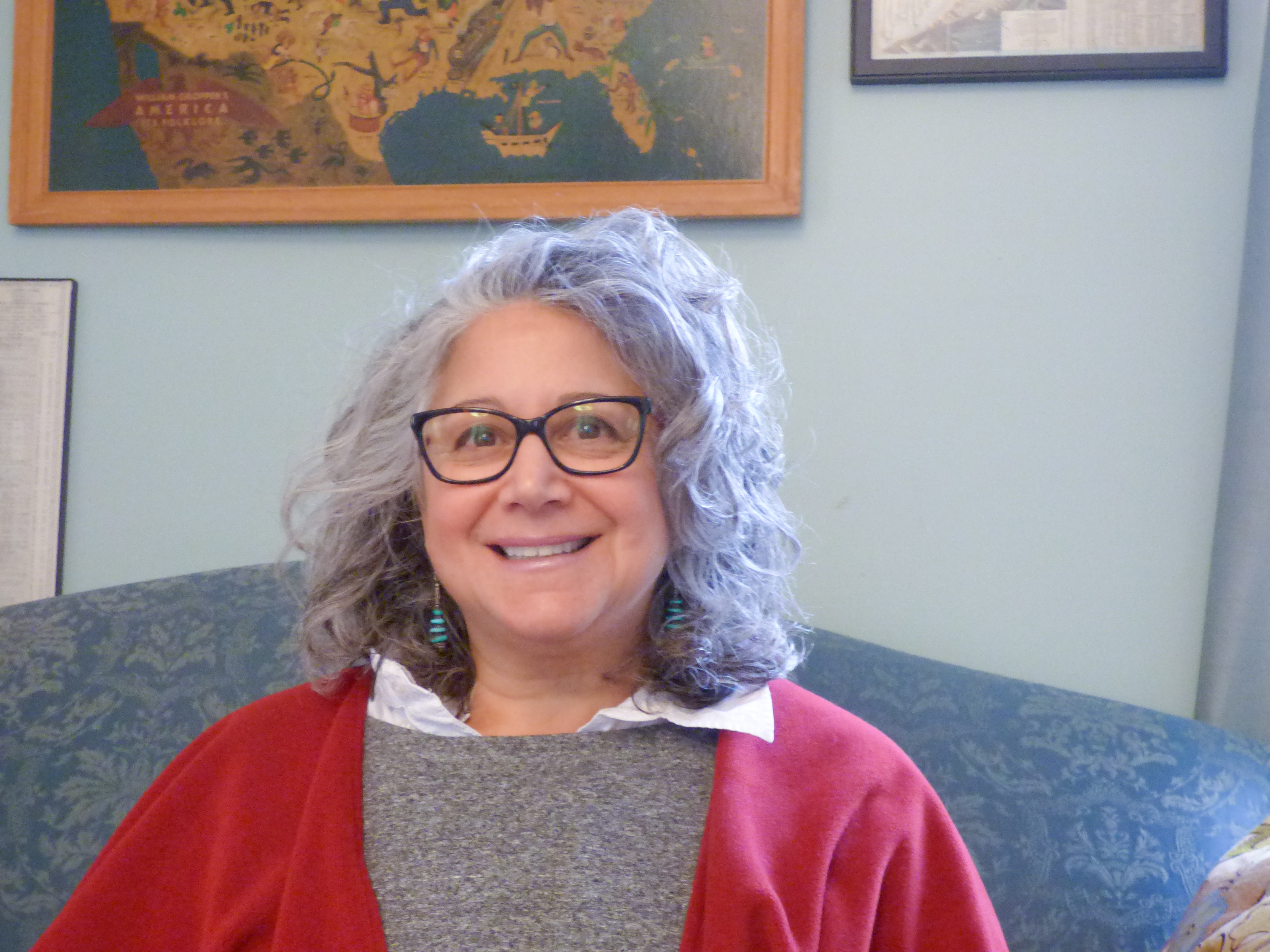
Karen Katz, November 18, 2015
-
interviewee
-
Karen Katz
-
interviewer
-
Anna Romskog
-
Date
-
2015-11-18
-
Subject
-
Cooperstown, NY
-
Niskayuna, NY
-
New York City, NY
-
Westchester, NY
-
Chicago, IL
-
Elmhurst, IL
-
New York University
-
Autism
-
Hyperlexia
-
Graphic Design
-
Center for Speech and Language Disorders
-
Education
-
Special Education
-
Applied Behavior Analysis (ABA)
-
Description
-
Karen Katz grew up in Niskayuna, NY. After graduating from college she moved to New York City and began working in publishing for a trade magazine and Billboard Magazine. She went back to school to earn a degree in publishing from New York University. After completing her degree she moved to Westchester where she worked for a few years before meeting her husband Jeff. They married in 1986 and moved to the Chicago area.
Karen has three sons: Nate, Robbie, and Joey. Her eldest, Nate, was the focus of much of the interview. Nate is high functioning autistic. He has a form of autism known as Hyperlexia, meaning he struggles to grasp verbal communication but has an affinity for written language. Karen and Jeff found out about Nate's communication issues when he was still a toddler and began treating him in Chicago where he and his brothers were born. Nate started in special education classrooms before being mainstreamed in second grade. They continued to living in Chicago until 2003 when they moved to Cooperstown. Karen discusses that part of the reason for the move was because of the school system available to them in Cooperstown for Nate and her two other boys.
Towards the end of the interview we discussed how education and therapy have continued for Nate in his adult years and what some of Karen and Jeff's concerns and fears for Nate are in relationship to the future, specifically how they are planning to care for him as they get older. A small but important portion of the interview focused on how autism affected the Katz family and may have changed the dynamic of the family altogether.
-
Transcription
-
Cooperstown Graduate Program
Oral History Project Fall 2015
AR=Anna Romskog
KK=Karen Katz
NK=Nate Katz
[START OF TRACK 1, 00:00]
AR:
It is November 18th [2015] and I'm Anna Romskog from the Cooperstown Graduate Program and I am going to be interviewing Karen Katz who lives in Cooperstown. How are you this morning Karen?
KK:
I'm great.
AR:
Good, I'm going to start off with a pretty simple question: Tell me about growing up in Niskayuna.
KK:
It was a really nice place to grow up. Upstate. There were a lot of scientists from GE [General Electric] who lived in Niskayuna. So the people tended to be very above average in terms of smart. And that's a big generalization but it's kind of true. There was a brilliant man who lived down the street who actually discovered the Big Bang Theory and there were just kind of extraordinary people all over the place. Maybe that was who my parents hung out with but it seemed like even in school with my friends and their parents people were quite interesting. Actually there was a Nobel Prize winner who lived up the street as well so it was kind of extraordinary.
AR:
Okay.
KK:
And growing up there was just great. It's a beautiful place, lots of apple trees. It's right on the Mohawk River and we hiked a lot and did a lot of outdoors things. At the same time I felt sort of like I didn't fit in and it wasn't until I was a little bit older and went to summer camp up in Maine and I met all these people who were from the city and these suburbs of New York that I realized that “Oh these were my people.” And no wonder I didn't quite fit in upstate because I'm probably more of a city person.
AR:
So you mentioned that you kind of found your people when you went to summer camp and some were from downstate, New York City. So tell me a little bit about New York City then. Because I know that you moved there at one point.
KK:
I did move there at one point. Both of my parents are from around the city so I think they brought that sensibility upstate with them. It was kind of obvious that they were not originally Upstaters. I mean it was obvious to me. I don't know, Anna, I can't really put it into words. I'm sorry.
AR:
Oh, that's okay. Don't worry. So when you did move to New York what did you do there?
KK:
I moved to New York in the early [19]80s after I graduated from college and I looked for
a job in journalism. That was very difficult to find so I found a job in publishing and I worked at a trade magazine. I was an editor at this trade magazine. It was over by the UN [United Nations], it was on the Upper East Side and it was great. I loved living in the city and I loved working in the city. I made really good friends. The job was fine; it was kind of brainless. It wasn't my dream job or anything but I was being paid to be an editor in the city and that was thrilling. I had a lot of friends there and then I took a job at Billboard Magazine freelance proofreading because they paid $12 an hour, which was an enormous amount of money. So I would finish my regular job, take the subway downtown because they were near Wall Street, they were all the way downtown near the seaport. I would take the train down there and I would work probably until midnight and then I would take the subway back home. And then I found out that my company would pay tuition if I went to school so I went to NYU [New York University] all at the same time. I went to NYU and got a degree in magazine publishing after work. It was all very exciting and I was busy all the time. I didn't really have extra money for anything but loved living in the city. On Tuesday nights there were pay by donation nights at museums and stuff so you could go and give just a couple dollars and go into all the great museums so there were endless things to see.
AR:
Okay, how did you meet your husband?
KK:
I met Jeff at a New Year's Eve party. The story is this. At that point I was living and working in Westchester. There was a publishing house in Westchester, I think I told you about it, it used to be a big old country club. It was a big Tudor mansion and it was a really fun place to work. I had had enough of the city at that point. So I moved up to Westchester, had my first apartment by myself, a little garden apartment with a bathroom and a refrigerator that I didn't have to share with anyone. So it was completely thrilling. I had a car. I had a job. We had a softball team at work that I played on; I was playing tennis with my friends from work. We would go out. It was a nice social life and I was feeling for the first time in my life completely self-contained. At that point I met Jeff this is how we met. My college roommate Nancy was from Scarsdale and she was living and working in the city but she still had friends and family in Scarsdale and it was going to be New Year's Eve and I wanted to go to a party in White Plains at a college friend's house and Nancy wanted to go to her friend's cousin's party in Scarsdale. She said there were going to be some people there. I guess her friend's cousin worked on Wall Street, so I went under protest. I said I do not want to be at a party with a whole bunch of Wall Street Republicans. I went under protest and I said I was just going to wait until we went to the second party. While I was waiting I met Jeff at the buffet table. We were standing next to each other and he was adorable and we started talking and that was it. We talked for the entire rest of the night. I never went to the second party. We had a little champagne toast at midnight and that was it. I mean I really knew right then that he was the one. Then interestingly he asked me that night if I wanted to come to Cooperstown with him because he had a couple of days off of work and he was driving up to Cooperstown and I said no. I said I don't know you I'm not going to get in a car and travel with you. So about two weeks later he got back and called me and we went out for our first date; which was we met at the information booth in Grand Central Station, right by the clock, and we went to the Museum of Modern Art and a Knicks game and we went out for barbeque. It's been him ever since. So that was New Year's Eve when the year turned to 1986.
AR:
So tell me a little bit about your kids. Because I know you have three of them.
KK:
I have three boys. The oldest is Nate, he's 25, he has special needs. He's high functioning autistic. He's probably a whole story in himself. You know, getting him diagnosed, realizing something was wrong with him, how he affected our relationship and the family; which in a nutshell was instead of us flying apart he brought everybody closer together. So he's 25, he lives at home with us; he is an artist. He's had exhibits and he sells his art and he's an absolute joy. He keeps improving developmentally which is a big surprise to me. I was thought he would hit puberty and sort of stop developing and he hasn't. So he continues to communicate better with us and he just completes the family. He's so integral to who we are. The other thing about Nate is he is absolutely a barometer of how I judge people. I look at how people are reacting to him and it helps me understand a lot about what type of person they are. So he's our oldest, he was born in 1990 when we lived out in Illinois, actually all the boys were born in Illinois. They were all born at Highland Park Hospital.
Robbie is our middle son; he is 22, going to be 23 in January. He is a naturalist, he loves animals; he always has loved animals and he's a senior at [SUNY] Oswego, studying zoology. He spent a year in Brazil on exchange; he's got an adventurous spirit and a sweet, sweet soul. Then Joey is the baby. [Calls to Jeff] He's 19 going to be 20 December 19th. Thank you. And he has definitely got a lot of artist in him too. He studies cinema studies, he likes film but he's an amazing musician and one of his gifts is kind of like noticing everything and seeing the whole picture. [To Jeff: Bye, see you later]. And he's at SUNY Purchase, which is the art school of the SUNYs. And they are just amazing, amazing people. So do you want me to tell you more about the boys? Any things specific you want to know about them?
AR:
Let's start with Nate. Tell me a little more about Nate and learning about your son and how to help him as much as you can.
KK:
Do you want to hear about when we first noticed that something was wrong with him, do you want to go back to that?
AR:
Sure, let's start there.
KK:
It's a good place to start. So he was our first kid and neither Jeff nor I had really any experience with kids, babies, anything like that. We were both working, I worked up until the day I had Nate. You know, I wasn't kid centric [phone buzzing] oop. Sorry. It's okay, I'm not going to answer it. We were not in a kid centric world; we were in a work world. And the only kids we knew were–we had a niece and nephew who we would go and play with once and a while. But our friends weren't really starting to have kids yet. Anyway, we didn't know about kids and then we had Nate and he developed normally up until he was, I don't know, about 18 months. At that point Jeff and I noticed some things and I went to the pediatrician regularly and I asked the pediatrician you know he's not doing the communication, he's not meeting these milestones. The doctor said not to worry about it. At the same time we could tell that he was brilliant, Nate was brilliant. He could talk but it was recitation. He didn't really interact but he would do things even at this young age, like put things in alphabetical order. He would take the magnetic letters and numbers on the fridge and spell things out. He was doing things that were beyond what the other kids in his playgroup were doing. So we knew he was brilliant but we also worried about the milestones he wasn't reaching. I used to say as long as he's happy but he started to really tantrum a lot and he wasn't happy because he couldn't express himself. So things sort of happened all at once. We had Robbie and one day I said, “You know, Nate cries more than the baby” and at the same time my mom back in Schenectady read an article in her local paper about a little boy with Hyperlexia. Hyperlexia is a form of autism and the newspaper article gave a little bullet list of what Hyperlexia looks like; precocious ability to read, lack of social interaction, a whole list. So my mom called me up and said I read about this little boy and he reminds me of Nate and she said I know you don't like me to tell you how to parent but I was desperate and I said send me the article. In the article the little boy had been helped by this place called the Center for Speech and Language Disorders located in Elmhurst, Illinois, 20 minutes down the highway from us. So I called the center and I started calling early one morning. I called one day and left a message for–there were two co-founders, one of them was in the Schenectady Gazette article and she was the one I called first, left a message for her. She never returned my call and by that point I was really frantic you know, something's wrong with my boy. The next morning, having not heard back from that co-founder I started calling the center at 7 a.m. and the other co-founder answered the phone. I talked to her about Nate and she said yup, you've got one and I said, “Can you help?” and she said, “Yeah.” That was just the best thing to hear. We started going down twice a week and she did, she helped. Her name was Phyllis Kupperman and she became like a second mother to me. That there was someone in the world who could tell us what was wrong with Nate and how to address it and who understood it enough to be able to predict what the next steps would be was sort of beyond words–it was the most amazing thing in the world to have that. And the worst part of Nate and his disability was not knowing what was wrong with him. Once we found out Jeff and I just kind of hooked arms and said okay we know what's wrong with him, let's do everything we can to fix it and it was an interesting, interesting process because Nate's ability to read became how we reached him. Phyllis said buy pads and pads of paper because you are going to be writing everything down and we scripted everything for him. It was overwhelming to think we were going to have to script every single thing for this little kid but the more he understood the less we had to write for him, you know? So we started out by writing down when someone asks you what is your name you say my name is Nate. And that's how he learned how to interact and how to talk. There were still many, many things that he didn't understand. It was as if English was a foreign language. He understood it when he read it, when he could slow things down. Do you speak a foreign language?
AR:
German.
KK:
So when you're in Germany and the words are coming at you very quickly you can pick out–well I think they're talking about a restaurant and I think they are saying this but you really don't get all the nuances and sometimes you miss the meaning completely. That's how Nate was with English. Then when you read German you're able to slow it down and you understand it much better right? That's how it was with Nate. So the things that he didn't understand, the things that were traumatic for him like transitions, we would just try to anticipate everything–write down lists, a lot of written schedules so nothing surprised him, a lot of checklists, like when he did a good job on things, reward charts, things like that. That's how we reached him. That and cookbooks. You see that shelf of cookbooks those are all kids cookbooks. Nate loved cookbooks, still does and loved to cook, and still does. So he would bring me a cookbook and that would be how we would interact. I would say oh you want to make something from the cookbook, what do you want to make? Use your words, tell me what you want to make. And it would be a whole–I mean it's forced to be interactive. Okay so we're going to double this recipe so one cup instead how many cups are we going to use. And the reward is a cake or whatever recipe we were working on. So little Nate standing on a stool next to me at the kitchen counter is a very, very happy memory.
AR:
How did he handle having little brothers? Because that's often a big change in families, so how did he handle that?
KK:
I think he hated it because he's very sensitive in terms of tactile things and the way things smell and stuff like that. So these little people showed up wearing stinky diapers and it was really hard for him. Once they grew out of diapers he loved them but when they were stinky little people he just had a hard time tolerating them. I have often said that his brothers were the best things for him in terms of social interaction; because they were in his face and he couldn't avoid them, they forced him to interact. I mean, he loves his brothers; he is crazy about them.
AR:
How about the transition to school because that's another big transition in a kid's life.
KK:
Well he started school early. He started school early because we had trouble keeping him in a preschool. I actually have trouble talking about this; this was a really painful time. I was trying to find a preschool that would accept Nate and I tried one and I was told that he–I don't know, there was a mom who said I don't want him drooling on my kid; just something so horribly not accurate and hurtful. I tried a couple of preschools, he was asked to leave a couple of preschools. That was horrible. And then I found out that the school district accommodates for kids with special needs and that there are special classes for pre-school age kids. So Nate went into one of those and it was great and he loved it. So he was a little kid and he was in this little class in our school district of kids with special needs. It was pretty much a one-on-one atmosphere. I think there were six kids in the classroom. And there was one teacher and maybe 4 or 5 aids so it was just phenomenal and that's what he needed. He loved school and he loved learning, and he still talks now about some of the things that he learned because they taught him with ABA [Applied Behavior Analysis]. It's a behavioral way of teaching kids. He had no choice but to learn and it was fantastic. So he learned how to be in a classroom, how to be with other kids, and then from there–that was preschool–from there he went to a very specialized, small classroom that was really heavy on behavioral teaching. It was in another district, he had to take the bus there but it was also just perfect placement for him. So the heavy-duty behavioral classroom, that was kindergarten and first grade, second grade the school district said they were ready to bring him into the classroom to be mainstreamed. And I was terrified and I said I don't think this is right, I don't think he's ready. I mean he really had so many social failings at that point and I said he's going to take away from the other kids and I still had stress from him being asked to leave preschool, so I really was a little gun shy about that whole situation. But everyone from the principal down to the special ed teachers said no this is where he needs to be, we want him back in the district. Again, phenomenal, phenomenal–the school district really understood Nate and
[START OF TRACK 2, 00:00]
they celebrated his gifts. That trickled down to the other students celebrating his gifts not saying, you know, “What's wrong with this kid?” because he was still very, very different. So school was like a godsend always. The school district was great and we had Phyllis and not that we were without [hard times]. It was definitely rough and we still have our rough moments but we set these goals for him in our school meetings that seemed unattainable to me and he would always meet the goals so we learned early on to have high expectations of him.
AR:
Talk a little bit about moving to Cooperstown because I know you started in Chicago with the boys and moved to Cooperstown in the early 2000s, is that correct?
KK:
We moved here in 2003. We bought a house that was going to be a sort of vacation house and then we came and stayed and really wanted to live here full time. It depended on the school because Nate was in 6th grade at that time, he would be going into 7th, and the high school in Illinois had 4,800 students. It was huge, it was a campus and they really didn't accommodate special needs kids well, as far as I was concerned. There was a pattern of them keeping the kids who weren't ready for high school in eighth grade, in middle school until they were ready. And it seemed to me that maybe Nate wouldn't be ready and maybe he would stay in eighth grade for a while. At the same time there were some older kids who I knew of who were starting to experiment with heavy drugs in the high school. So the high school was raising a lot of red flags for me not just with Nate but with other boys. On one of our little weekends here, I guess it was a week long, it was during a winter break–we were on winter break but they still had school here. We went over to the school and met with the special ed people and they were great and the schools felt really comfortable and the people obviously were sophisticated with kids with special needs. I mean for a small school district it was kind of amazing. So we moved here in the summer of '03, in June and the kids started school that next September. Again it was amazing, amazing placement for all the boys. Everyone blossomed here. Anything specifically you wanted to know about?
AR:
How did the whole family handle the transition from a big city to a small town?
KK:
I thought it was going to be a difficult transition for all of us, and it was a difficult transition for none of us. It fit. I think as long as the family was together it didn't really matter but the boys made friends right away. I think there are definitely things that we all still miss, even now we all still miss about Chicago but we go back once or twice a year and we get our fill. We eat the foods that we miss, we see the people that we miss and it's still home to the boys. It was fine; it was an okay transition.
AR:
You mentioned a little bit earlier that Nate kind of had a way of bringing your family together instead of pushing them apart. Can you talk a little bit about how he did that for you?
KK:
Well, this might ramble a little bit. I have a sister who has special needs and I grew up with my parents expecting me to take care of her, which I resented, I still do. So Jeff and I never asked Robbie and Joey to do anything for Nate. We never said he's your brother; you have to look after him. We never put that on them. I mean they are little kids; it's hard enough having someone with special needs. He really always took so much attention that we always kind of tried to make sure the balance was there with the other boys. But the thing is that Robbie and Joey instinctively look after Nate, without being asked and without being told. You can tell that they're always–it's like a sixth sense–they're always aware of where he is and what he's doing. They sweetly look after him. In terms of Jeff and I you don't know what kind of a parent the person you're marrying is going to be and I didn't know what Jeff was going to be like and he didn't know what I was going to be like and as soon as Nate got diagnosed, as I said before it was like we just came together and both of our instincts were exactly the same whenever there was a decision to be made. Whenever it came to Nate we were just in step. And Robbie and Joey never knew anything other than having Nate as a brother so they were born into this family where I think there was just a very–I'm trying to think how to put it into words–it's an unspoken bond of protection; that we have this kid that we sort of have to look out for. Is someone looking sideways? Is he doing something wrong? Does he need anything? It's quiet in the other room, what's he doing? We just, all of us kind of have this protection of Nate running through us. And there he is. Hi Nate.
NK:
Hello.
KK:
Nate, this is Anna.
NK:
Hi Anna.
AR:
Hi Nate.
KK:
So, does that answer your question?
AR:
Oh yeah.
KK:
Okay, it's really hard to put into words though. It's really sort of something that I understand in retrospect. Looking at Robbie and Joey now as young adults and looking at how they act with other people and just the kind of people they are–like one day I was picking up one of them at school and I saw somebody come out of school and he looked like disheveled or something and I said–it was Robbie, I picked up Robbie and I said Robbie what's up with that kid and he goes, oh he's a good kid. And he got protective of–you could tell that how he reacts to Nate extends to everyone. I kind of wanted to know what's up with him and he wouldn't let me go to a negative place with that, you know what I mean?
AR:
Mhm.
KK:
I think because of Nate none of us tend to judge people. We don't pre-judge and we tend to understand that every single person has struggles. So we'll look at someone and we'll say you know, I wonder what they're struggling with rather than what's his problem. So it's this built in foundation of who we are and certainly I was maybe a little bit like that before Nate. But Jeff wasn't and we've just become better people. We became better probably in every single way and then the boys were just born into that. Pretty phenomenal.
AR:
Yeah. It's amazing to see what a person can do to change a family, to change the entire culture of the family.
KK:
One of the things is if you set out to change people you probably won't, so there are things that–I mean changing a person is so difficult to implement and it's that this happened on a level in our family that was unspoken and unintended; it's kind of remarkable.
AR:
So I just have a couple of questions to just wrap things up. You mentioned much earlier, when we were just starting to talk about Nate that the school with you and Jeff would set really high goals for him, things that seemed unattainable. Do you guys still set goals for him?
KK:
We do. It's not as structured as it was but he is structured and he needs structure so he forces us to kind of build schedules and goals into his life. He's best when he is working on a project or a goal. Whether it's working on his Etsy site or his t-shirt line or–we have a lot of social goals that we still work with him on and he has help from Springbrook and the Arc Otsego. He works with a young man. For instance, this week the goal was to go to the grocery store and do shopping by himself. So Kyle, the young man who is helping him with these things, sort of shadowed him as he walked to the grocery store with a list and did all that. So yeah, our goal is to be able to leave this world and have Nate be as high functioning and as self-sufficient an adult as possible. So yeah, we continue to set goals. And sometimes it's little. I mean, he's fairly independent but he can also be socially inappropriate so we'll go down to Wal-Mart, okay? He likes to take his own cart and go off in the store by himself, so he has a telephone, I'll make sure it's turned on, I'll call him, you know, while we're shopping, and I'll say where are you and he'll go, oh I'm over by the magazines, and I'll say come and meet me by the produce. But back to goals, when he goes away pushing his shopping cart I'll say to him Nate, don't talk to yourself because he tends to talk out loud and it looks a little strange so I want him to visually fit in as much as he can. So yeah, still goals, probably always.
AR:
How have your fears or worries about Nate changed or have they changed as he's gotten older?
KK:
So I went away this weekend and I stayed in a hotel room with my parents. I had a bed and they had a bed and I had a dream that I lost Nate and my father told me that in the morning I sat up and I said she found him and then I went back to sleep. I worry about him all the time. My fears mostly have to do with other people not understanding him or him not making himself understood to other people. My biggest fear is me not being here and that's a reality. I'm not going to be here all the time for him. We've set things up–monetarily we've set things up for Nate so he'll be okay and we've talked to his brothers about what's going to happen when he's older; there's going to be money for him and this house can always be his and we'll maybe pay for someone to be with him. When we were telling the boys that both of them said well we're going to take care of him, he's our brother. Which was quite lovely and Jeff and I both said no, we don't expect that of you, it's not necessary but they both kind of–I think they might just kind of have it built in that Nate might be part of their lives. Which that's pretty wonderful but I wouldn't put that on them and I wouldn't wish that on them because he's not their responsibility, he shouldn't be there responsibility. But here's this kid, you know he's graduated from high school, he's gone to college, he's graduated from college. I think my fears are less and less–the more the world understands autism and the more the world sort of understands differences, and I think that society is becoming much more understanding about that. When Nate was born there was not much understanding of autism or special needs and in 25 years the world's changed a lot. [Coughs] Excuse me. [Coughs] Sorry. I have heard that there's a school of thought that autism is actually a higher form of evolution and there are people who are looking at autism now not so much as a disability but maybe as more of a gift. So as long as we're in that kind of a world I think we're okay. There are lots of things that I'm still working on, that I'll continue to work on, maybe like a group home setting or an assisted living situation for Nate and some other people so he can do some kind of transition from living with us to being in the world a little bit more and to being more independent because he's really dependent on us right now. Jeff takes care of his finances and we take care of pretty much all of his needs. He's independent to a point but not everything. So like living situation. [To Nate] Oh you know what? You might need that haircut today. Yeah I think we're going to get a haircut today. Anyway, where was I?
AR:
Living situation.
KK:
There are always kind of going to be worries, there are always going to be fears. There are always worries and fears with Robbie and Joey as well. I actually feel a lot safer about Nate because he's under our roof and he's not out in the world driving around and hanging around in the city with pickpockets and stuff like that. I mean it's the nature of being a parent to have worries and fears. I don't know.
AR:
That's okay. [Laughs] I think this might be where I wrap it up just thank you so much for your time and being willing to share with us. It sounds like you and your family have an amazing dynamic and have learned a lot through the experience of having Nate and two other boys who sound wonderful. Thank you again for all your time.
KK:
You're welcome, you're welcome. It's a pleasure talking about it. It's not easy to talk about. It's not anything that anyone would wish for but it's amazing the amount of joy he brings us. And that's not sugar coating it. I don't like when people say God wouldn't give you anything you couldn't handle and things like that. It's more than that. He enriches our lives as much as the other boys do and I think a lot of people think that it's a burden. It is restrictive to some level to have a kid; I mean a 25-year-old living with us. Jeff and I tag-team really, really seamlessly. We make sure that one of us is home and it doesn't feel like a burden because we've just kind of built it in and he's a joyful person in a house that would be an empty nest right now but it's not because Nate's here. He enriches our lives. So thanks for listening. [Laughs]
AR:
You're welcome. Thank you again for your time.
KK:
You're welcome.
[END OF TRACK 2, 26:15]
-
Coverage
-
Upstate New York
-
New York City, NY
-
Greater Chicago Area
-
1960-2015
-
Creator
-
Anna Romskog
-
Publisher
-
Cooperstown Graduate Program, State University of New York-College at Oneonta
-
Rights
-
Cooperstown Graduate Association, Cooperstown, NY
-
Format
-
audio/mpeg
-
28.8mB
-
audio/mpeg
-
25.2mB
-
image/jpeg
-
7.2mB
-
Language
-
en-US
-
Type
-
Sound
-
Image
-
Identifier
-
15-009
-
Original Format
-
Digital